header image
 

Lifestream 4

While discussing uncanny pedagogies, Bayne (2010) lists Lifestream as an example of something that captures the spectrality of one’s digital existence. What is this digital existence? Hook (2005 in Bayne, 2010) deconstructs it as a ‘disembodied presence’ and, what is more interesting, an ‘embodied absence’. Although the latter refers to the presence of our representation online while we go offline it is fascinating to see how this absent presence, instead of being static and fixed, is dynamic and subject to constant activity

The lifestream by being an example of a digital text, that is volatile, fragmented, distributable and doubtful in terms of its authorship (Bayne 2010) illustrates this dynamism very well, especially in terms of temporal and ontological blurring.

Unable to log on every day, I create discontinuity in the stream. However, the software sometimes fills in those gaps by tampering with the time stamp of a given feed. So although physically offline one day, it looks like I am present. Would that be an example of disembodied presence, a very convoluted example due to the feed being time-stamped backwards!? This happens because the software seems to be taking into account the date the online resource was posted, not when I favourited it. So to make things even stranger my absence/presence has been embodied by somebody else’s online activity.

Immediate questions arise as to the authorship. Who is creating this stream? How can you-not-being-there be assessed ? Uncanny indeed!


Category:  lifestreammaries      Tagged: , ,

Limit to Limitlessness?

The ‘unheimliche’ liquidises boundaries in various areas of ontological significance and so disrupts the sense of presence, time, space, nodding to Delueze and Guattari’s interweaving concepts of deterritorialisation and reterritorialisation. Due to that, online learners and tutors are rendered as spectres and ghosts often experiencing an ontological dissonance, being at a loss where to position themselves in the new online landscape.

So, the classroom has been emptied with the students and tutors fleeing online to populate and interact, supposedly often in greater intimacy, in multiple online spaces. The material reality of ‘here’ has given way to imagined ‘there’, a fluid space with ‘few, if any fixed compass bearings’ (Barnett, 2007). The physical body has been discarded too in favour of the spectrality, the disembodied presence , strangely enough, the embodied absence, the representation of you living online long after you’ve logged off. The temporal and multiple synchronicity deepens the ontological blurring even more.

Instead of attempting to normalise the situation by bridging the gap created by temporal and spatial disjunctures, Bayne (2010) suggests embracing thus induced uncertainty as something generative, constructive and transformative.

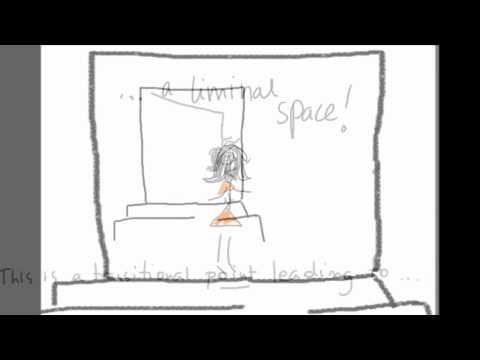
In general I agree with such a proposition – planes of doubt look to me as environments which might be more conducive to creativity than fixed frames of traditional practices and the liminal space of becoming seems much more interesting than the fixed point of departure or the destination, something I tried to capture in my video on liminal spaces I produced last year for IDEL.
YouTube Preview Image

There is however one issue I’ve got with the ontological turn the uncanny pedagogies are trying to implement. What is the limit of stretching one’s capacity for assimilating and producing strangeness? Is there a limit? Should this be even mentioned in the discourse with lack of boundaries as the basic premise?

If I’m rendered a ghost online how can online-me be there or anywhere? Does haunting equal being? What could anchor me in the online environment? Even the lifestream seems a hoax, breadcrumbs left by me but swept and arranged by technology according to its will. A fabricated piece of evidence. The growing isolation. The mounting uncertainty. The fragmentation of me, the online doppelganers render the physical-me a ghost too, as I close off from the physical reality and latch onto the online. I am neither there or here. It might be a productive space, yes, but there are limits to how much of intellectual uncertainty an individual can bear without going insane. Or is that a part of the ontological turn too, reaching the threshold of tolerance where the balance is tipped and you plunge/are thrown into the deep waters? Perhaps the limit I’m feeling frustratingly as very close is like other boundaries, ‘illusions, wisps of white that beckon to use just out of reach, that dissolve as we pass our hands in front of our faces’ (Kochhnar-Lindgren, 2009:5).


Category:  musings ,readings      Tagged: , ,

Lo and behold …

My visual artefact on the theme of dystopia and technology ….

YouTube Preview Image

A bit of background:

To paraphrase Lennon, my visual artefact is what happens while you’re busy planning something else.

The original idea was to be neutral -something that would combine dystopic and utopian views and possibly blur the dichotomy of the opposite outlooks in the vein of the rhisome theory (which really resonates with me). A very initial attempt can be seen as my ‘Virtual Mediation 2‘. My visual artefact was to be a follow-up on this idea but instead of pictures it was to make use of videos.

However, after spending a day trying to work out the video editing software I gave up and hence the rather pessimistic clip. It still needs tweaking – I could spend hours if not days syncing the audio tracks, captions and two videos, something I’d love to do but can’t afford at the moment.

So, there you are - what can I say – grim as it is, enjoy it!

Category:  visual artefact      Tagged: ,

Lifestream 3

My perception of the lifestream is undergoing a constant change and as it is being felted to use a rhizome-related metaphor (Bayne, 2004). First I saw it as a mere aggregating tool. Thanks to Carol’s post, I saw it’s something richer than just a piece of software recording my online activity (like a kind of an electroencephalograph). Her reference to streaming as writing struck me initially as odd but having thought of it I can see parallels between the lifestream and an ‘extended text’. There is an underlying structure, vaguely shaped by the module themes and discussions and the seemingly chronological order of releasing the feeds into the stream with the most recent ones at the top; an element of striation? Simultaneously though, there is still room for ‘lines of flight’ in form of acts  de/re-territorialisation, smoothness and unbounded liquidity as well as multimodality (various forms of communications – from shreds of informal conversations to more formal writings – and modes -from text through visuals to mash-ups . This rhisomatic take on the lifestream was taken even further by the subsequent comments made by Jen on the active role of the software in how the stream presents itself to the author (me) and the audience. There is an apparent diffusion of power over the meaning-creating process – ‘writing’ and ‘reading’ become more participatory, a positively disruptive experience, enhanced even more when you think of the technology being an agent and stakeholder in the process.

Lifestream Spiral

Pic SPIRAL by Kyoko Nagashima

Category:  lifestreammaries      Tagged: , ,

The Monster is Within

While reading Margrit Shildrick’s paper on monsters, I couldn’t help seeing parallels between a female body she uses as an exponent of a monstrous body and a digital body (being it an individual avatar or technology in general). Shildrick lists characteristics of female bodies (and the bodies of other ‘others’) such as leaky, unstable, labile, unbounded and uncontained, always in flux, subject to change, reproducing, excessive and in surplus, which assist the body in making the transition from the comfortable absence (‘comfortable’ when the body is looked at bounded and stable) to troublesome presence, whereby the body with all its frivolity and volatility imprints itself in the consciousness. It’s the celebration of the monstrous body – Shildrick proclaims at the beginning of her paper.

The reasons for such festive inclinations are numerous but the most important one is that of the need to emphasise the process, the flux, the instability as inherently natural and human.  This way she avoids positioning herself as an opponent of humanism as abandoning binary dichotomies and blurring the boundaries might establish, in her view, a  rich breeding ground, where transformation is born, which echoes the rhizome proposal of Deleuze and Guattari.

What Shildrick also stresses in her paper is the promise embodied in the liquidity, not the threat. While reading about the uncanny digital technologies last year I was not sure if the fragmentation caused by the multiplying online traces of my digital escapades and practices are something worth seeking after. I felt simultaneously attracted and threatened by the prospect, thrilled by the enhanced modes of being and feeling but alarmed by the possibility of losing sanity, succumbing to the power of my avatars, becoming dehumanised, the everlasting friction between the technoutopia and dystopia, a view still entrenched in ‘either … or’ perception of the world and subjectivity, based on binarism and thus on exclusion. The exclusion can never be complete according to Shildrick as the boundaries are liquid and permeable, allowing multiple incorporations which are at the forefront when it comes to innovation, creativity and imagination and so opening up different world, modes of being and becoming. This is a richer reality, enlarging not restricting  human subjectivity, embodying it and not disembodying.

While researching monstrous bodies I came across digital manipulations of the human body in art, crossing the boundaries between the human and machinic, between the disabled and the healthy. One of the projects struck me in particular. In the process of digital imagining the basic senes of smell, sight, taste and hearing got overgrown with thick layers of skin (thus excluded), giving an overall grim and dystopic look to the technological face, this way probably emphasising the desensitising threats. I would argue that this could be indeed the case if we persist identifying and maintaining the boundaries sealed.

The eyeless body might appear anti-human but uncannily by liquidising some of the senses and leaving one, the skin a very sensitive organ, it fosters new receptiveness.


Category:  musings ,readings      Tagged: , ,

Lifestream 2

Still playing with my stream, mastering it (by the way ‘master’ is an anagram of ‘stream’).
What does ‘stream’ mean?
To discover what it means for me, I invite you to play with the letters below:

Category:  lifestreammaries      Tagged: , ,

Descending the Trees

Could ‘digital culture’ refer to ‘an essentially heterogeneous reality’, a flattened ‘plane of consistency’ where’lines of segmentarity’ and ‘lines of flight’ weave into each other, excluding a dichotomy, and a relationship of power, a rhizome in one word (Deleuze & Guattari, 1987).

My analysis of a term into a root word and a modifier can be easily traced back to a syntactic tree structure where the noun forms a head and the adjective takes the subjugated position of a specifier. With Chomskyan transformational-generative grammar forming part of my background, I can’t help seeing the language in forms of aborescent structures, maybe rich the complexity of layers but with dichotomous relationships as an underlying organising principle. I can see movements mapped our but always with clear ports of departure and clear destinations, all of them subject to rules of government and power. Yet, according to Deleuze and Guattari (1987), this representation of the linguistic reality is not abstract enough …

****

If the language is  indeed closely related to culture, then my linguistic musings on the nature of ‘digital culture’ are devoid of substance. If ‘digital culture’ is analysed from the rhizome perspective, the relationship between the two can be seen in a surprisingly different light.

Disassembling ...

Like in the famous example of a wasp and an orchid as a visualisation of the processes of deterritorialisation and reterritorialisation, the culture deterritorialises by becoming detached, disembodied and dis-embedded from its temporal and spatial contexts (Hand, 2008) as it flows into the capillaries of the Web as information. The ubiquity allows the digital to reterritorialise – ‘the project of everware is nothing less than the colonisation of everyday life by technology’ (Greenfield, 2006 in Hand, 2008) (although the term ‘colonisation’ reintroduces the notions of power). However, simultaneously, it is deterritorialised as it becomes part of the ubiquitous culture (by being infiltrated and taken over, to use Hand’s ‘power’ discourse) and then it reterritorialises the culture by transporting its artefacts.

The result is an emergence of new concepts and convergence of thereof with existing objects and practices, producing novel understandings (Hand, 2008). In the process of aggregation, repurposing, mashing-up and creative recombination, new cultural artefacts are released into the circulation (Off Book Visual Culture Online or Life in a Day)

This way the notion of imitation can be excluded as the claim that digital culture is a form of culture (either superior in utopian terms of inferior, disruptive in dystopic terms) does not hold truth any more as there are no universals, no dualisms. Rather  fragments of code characteristic for one and the other are captured and mutually exchanged allowing the digital and the culture to become the other, a becoming-digital of the culture and a becoming-culture of the digital. The boundaries are blurred in the most fantastic post-human fashion (think also of the flattened relationship between the symbol and the signified as described by Kristeva and further illustrated  by Bayne, 2008 in her example of how the avatar – the digital- often becomes what it signifies, that is the identity of the user). If so, there can be no clear answer whether digital cultures bring a promise or a threat, a utopian or a dystopic future as they are not subject to a cause-and-effect representation but a much more complex multiplicity, a machinic assemblage, surprisingly a relief for a person brought up on Chomskyan trees.

... and reassembling!


Category:  readings      Tagged: , , , ,

Post Scriptum …

… to my Week 1 Lifestream Summary.

I went for a wordle representation of the beginnings of my lifestream because I feel it is still in its infancy, when it’s being shaped out of a mass of disorganised threads, scraps and traces left by me on the Web. I wove the word cloud with short statements signalling different moments of the first week formative phase: moments of panic when the computer crashed and when the pages loaded slowly but also moments of apprehension when I couldn’t get to grips with the whole concept of lifestreaming, analysing each link whether it was ‘postable’, feeling the ‘stick’ of assessment but wanting to be fair in choices as for me the course is about Learning, not passing.


When posting quotes from Hand (2008) on Tumblr, I started looking for images of ‘circulation’, ‘deterritorialisation’, ‘networks’ and while selecting the pictures the ideas started slowly milling around in my head, strengthened with time by visual associations. At night, the fermenting scraps of online activity built into new understandings and a few new connections were forged between the concepts. I’m still struggling with them but I wouldn’t have made this little step if it weren’t for the lifestream. What if I had a port built into my brain which would transmit my entangled thoughts into the lifestream, with a little sizzling sound here and there to document a small connection being temporarily secured?


Lifestream by Night


Category:  lifestreammaries ,musings      Tagged:

Lifestream 1

Wordle: W1S

Category:  lifestreammaries      Tagged: , ,

Moveo ergo sum

I am a human and as such I am rational, autonomous and have free-will, right? Yet, why do I so often tremble, unsure of myself and world around me? Why do I feel I am on a constant quest, unable to settle down, unable to be ‘one’, but undergoing transformation and fragmentation, me being an echo of past selfs and a sum of a number of present selfs and would-be selfs?

***

Among different threats related to the globally rising prevalence of digital technologies, Hand lists ‘liquefaction’ of traditional institutions and practices. The humanistic stability of the self could also be subject to this process. Bauman (2000) pointed at  uncertainty as pervasive characteristics of liquid modernity. He illustrates this further by referring to notions of chaos, fluidity and ambivalence and describes a liquid modern man as a nomad or a tourist, responsible for weaving his life himself. Being in  perpetual motion and executing the freedom of one’s own making have become a mode of being.

The collapse of stability and the never-ending changes a human undergoes through the course of their life seem to be at the forefront of posthumanism (based only on preliminary reading), which also conceives the posthuman as an ‘emergent ontology’, thus emphasising the importance of becoming, hosting multiple identities and perceiving the world from a number of perspectives.

Again rapid digitisation and the transformation of culture into digital culture is possibly instrumental in this process of posthumanisation of a human(Hand 2008) or even their cyborgisation.

Is this liquefaction liberating or threatening in regard to our agency and the choices we make, our free will? If none of the universal truths can be trusted any more in the times of supercomplexity and if reality is to be observed through a number of perspectives, perhaps the notions of agency and ‘free will’ lose their validity, especially when multiple identities are at stake? It appears a whole new mindset is needed …


Liquid Man

Pic by Chris Wardle-Cousins.


Category:  readings      Tagged: , , , ,