Summary: Week 6

Its hard to believe that we are already half way through the term.  The life stream is a great way to review my journey through the course content and I really have the feeling that the content I’m pushing into it is becoming more focused each week.  This week I continued my arrival story into the Diaspora network.  In last weeks post I speculated that the arrival into a social network is more about making connections than something as simple as account creation, and I’ve definitely made some very interesting connections thus far.  Of course my interactions are filtered by the hashtags that I’m following, and no doubt there exist other groups who follow different ideas within the overall Diaspora network.  Indeed, since each user chooses to follow their own personal set of hastags, each belongs to an overlapping set of interest groups.  But I still get the feeling that there is a common shared identity amongst Diaspora members, an identity characterised by politically and socially motivated (lifestream 26.10.11 #4), technically literate and (from my perspective at least), interesting people.  The excellent quote in Bardzell & Odom (lifestream 24.10.11 #5) reminded me that if one member of a group likes film trivia while another prefers astronomy, any sharing that takes place between them is more meaningful that the actual content being shared.

As an aside to my own arrival story, I wanted to get a picture of Diasporas own arrival story (ie its inception) for use in my ethnography.  The motivation to build the network followed Eben Moglens excellent Freedom in the Cloud lecture (lifestream #2, 21.10.11), something that also affected me very deeply on my first viewing.  I also collected some other videos (lifestream #2, 21.10.11) on this subject as well as one interesting competitor.

Immersing myself in technical subjects and conversing with technical Diaspora members prompted me to do a little investigation of the software underlying the technology.  This introduced me to Collaboration Graphs and the game, Six Degrees of Kevin Bacon (lifestream 24.10.11 #2) which reminds us that the real power of social networks and graph databases is the uncovering of connections we never imagined existing before.

Summary: Week 5

Week five already and I am deep into the groundwork for the digital ethnographic study.  I began this week by getting a good understanding of the practices involved in ethnographic research (lifestream 18.10.2011, #2, #3, #4 and #5).  I noted with interest how ethnographic research has found its way out of academia and into the field of Internet marketing (lifestream 18.10.2011 #6) which prompted me to start thinking about the nature of communities, their rules (18.10.2011 #7) and how the bounds of group membership are actually defined (lifestream 19.10.2011 #4).  The Bell text from this weeks reading helped to clarify that somewhat.  I was introduced to the concepts of Gemeinschaft and Gesellschaft (lifestream 20.10.2011 #4) and commented on a similar topic in the Holyrood Park discussion forum.  After considering these ideas, my first impulse was to focus my study on an online Star Wars gaming community of several hundred active members.  However this target community would be difficult to examine given the casual nature of membership and the ability for players that die to respawn with new identities.  The fantasy element also presented a problem when I considered the definition of ethnography as participation given by Hammersley and Atkinson, quoted in Hine in the core readings for this week, that “the researcher does not just observe at close quarters, but interacts with the researched to ask questions and gain the insights into life that comes from doing as well as seeing” (Hine, 2000).  Instead I settled on an newly launched social network named Diaspora which espouses choice, freedom and member ownership of data.

The Hine reading, as well as my personal study for the week got me thinking about the concept of arrival stories within ethnographic research and so I began considering what represents an arrival (and here) within a cyber-community.  In the online community with a prescribed signup process, membership is a highly defined concept, i.e. if you have an account you are by definition a member.  Group membership therefore is insufficient to define ones connection within an online community.  Perhaps the missing element is the idea of reputation within the group, or a general acceptance that the new member is willing to work within the established community guidelines and participate in a productive way.  If this is true then the “arrival” is the creation of connections within the group rather than mere membership.

I’m really looking forward to getting involved with Diaspora and developing these ideas further.

Summary: Week 4

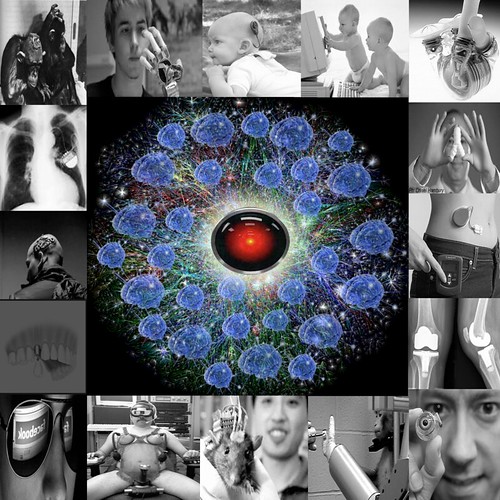
This week we’ve focused on the theme of digital literacies with a particular emphasis on the visual.  We have each explored some really stimulating ideas through the production of a visual artefact, and it has been interesting to notice how each of us interprets one anothers work differently (lifestream 14.10.2011 #1).  The title of my own artefact, We Are The Web, reflects my belief that while the Internet may be produced by people, in many ways it also is people.  It is live and interactive, and for those of us who live and work within it, it is becoming an extension of ourselves.  We are drawing ever closer into a symbiosis with technology, and while this can offer many conveniences, my fear is that we may be blinded by the benefits while ignoring the potential dangers (lifestream 11.10.2011 #6 – music video).

Siân has commented on my emphasis of “the implant and the prosthesis”, while Grace notes the discomfort shown in some of the images that I’ve selected to be part of the piece.  This was a very deliberate choice that I made when creating the image, because for me, our love affair with technology is something that we have forced upon ourselves.  It is an unnatural coupling and something that requires us to actively modify both ourselves and our behaviour if we are to reap the rewards.

To express such complex ideas visually is particularly challenging, especially when we consider the many influences affecting the way that we interpret images, combined with the fact that images must be seen in context if they are to be understood at all.  In order to better address these issues, I did some surfing and discovered amongst other resources, a brilliant presentation by Doug Belshaw entitled The Essential Elements Of Digital Literacies (lifestream 12.10.2011 #1) as well as some excellent and free online graphics tools (lifestream 12.10.2011 #2).  Visual literacy is without question an essential skill for todays learner, and definitely something that I’ve become more sensitive to during the course of the last week.


Visual Artefact 1.0

Hi web,

Here’s my first stab at a visual artefact:

We are the Web

Or a high rez version here:
http://www.flickr.com/photos/danielgriffinnet/6235758794/

Flickr members feel free to comment there, or here, whichever you prefer.  I’m still undecided on a title for this.. perhaps “We are the Web” might suit.

D


Summary: Week 3

This week my attention has been split between the the ideas of uncanny and ghostlyness encountered in the Bayne paper, as well as our discussions around digital literacy, visual literacy and new forms of learning.  Pulling these ideas together into one short weekly summary is proving to be quite a challenge, so I have been thinking allot about where the intersections between these concepts lie.  Perhaps it is a question of multiple interpretations, of multiple view points, multiple versions and non formalized learning experiences.

Following our discussions of the “uncanny” I began to think about the online ghosts or echos of dead content which still exist in some form, say perhaps in a wiki version history or a Google cached page (lifestream 09.10.2011 #1).  Such data, when it “lived”, might have been considered absolute and definitive, but through constant editing and revision combined with new insights into old knowledge, it has lost its currency and been replaced or updated.  Yet it exists and in many cases is still accessible, thus offering the interested researcher a unique view into the process of learning and refinement that occurred in a given knowledge domain.

A slightly different interpretation of the uncanny can be seen in the result new literacies produce within our existing structures and modes of learning.  The emergence of new literacy skills such as crowd sourced tagging and folksonomy creation “that is controlled by the community of users, rather than an elite group”, (Merchant, 2007) challenges the traditional structures and hierarchies of knowledge coding and classification within the academy.  Given the possibilities for vague usage or personal interpretations of meaning, such informal metadata can produce very different views into a body of knowledge.  When viewed from one perspective verses another (based on something as simple as changing the tags used as filters), one can see the many potential sets of interpretation that might occur.  This truly is a ghost in the machine, an unintended consequence of the growing complexity of the system.  But this ghost need not terrify us. There is nothing false or incorrect about such views into datasets, indeed one might legitimately claim that these ghosts can compliment one another, offering learners the chance at a richer and more complete understanding of a knowledge domain through a “generative uncanny pedagogy”, (Bayne, 2010).

Digital Narcissism?

My fellow classmate Kevin recently used the term Digital Narcissism to describe a phenomenon which seems to be commonplace over the web and is becoming more apparent within our offline culture too.  Mark Zuckerberg, has been quoted as saying that “a squirrel dying in front of your house may be more relevant to your interests right now than people dying in Africa”, and perhaps on some immediate and mundane level, our personal daily experiences are more important to us than the broader world because they are unique to us and consequently noteworthy.  We live within an ever expanding world, a world of media saturation and constant noise, a world in which a unique thought can sometimes be a rarity or something to be shouted out for all to hear.

It’s something that I’ve often considered after seeing Mike Wesch’s excellent lecture on digital ethnography and youtube,  The Machine is (Changing) Us: YouTube and the Politics of Authenticity.  In this lecture Wesch quotes Henry Canby speaking in 1926 about the side effects of urban life and cities, saying that, “what we are encountering is panicky, an almost hysterical attempt to escape the deadly anonymity of modern life … and the prime cause is not vanity … but the craving of people who feel their personality sinking lower and lower into the whirl of indistinguishable atoms to be lost in a mass civilization”.  Wesch goes on to describe this sense of personal loss as a possible cause for the current voracious public interest in the subjects of popularity and celebrity, explaining that if the conversations of a the culture are happening on television, which is essentially a “one way conversation”, then unless you are on television you are without a voice.  This would certainly help to explain the ever increasing number of blogs and vlogs online, but it is somewhat disheartening to consider the search for an audience as a search for recognition amongst a culture losing its sense of self worth.

Given the sheer volume level and noise produced by this massive chorus of voices, each striving to be heard above the others, is it any wonder then that Guy Debord has claimed that the world has turned into a ‘society of the spectacle’? (Debord, 1977, quoted in Rose, 2007).  A society where each voice needs to be louder than the others if it is to be noticed?


Summary: Week 2

This week we’ve been considering the themes of Being Human and Other Worlds (lifestream 04.10.2011 #5).  Being somewhat of a gamer and virtual reality hobbyist, the notion of Other Worlds holds particular interest for me and seems to tie in well with the readings and discussions from last week.  However my ramblings across the web while considering this topic have started to get me thinking about the nature of this reality and how we experience it.  If all of our neural impulses are prompted by nothing more than electrical signals from our nervous system, then we are each of us living inside our own heads.  Each of us is experiencing their own virtual reality and no doubt colouring it with the emotional or experiential baggage that defines us.  When considered thus, we can actually make the astonishing claim that there is no such thing as one absolute definition of reality.  Indeed the very reality that we experience can never be truly shared because the sharing must take place via our nervous systems.  It’s almost analogous to the idea of different game play experiences due to graphics card irregularities or broadband speeds amongst gamers.

Considering all this, and if we really are just brains in meat vats (lifestream 01.10.2011 #1), experiencing the world through our senses (plus the technological prosthesis we attach to them, i.e. networks, monitoring software, information systems, etc), how can we ever hope to share a common culture, digital or otherwise?  How can we be sure that our interpretation of anything is close enough to that which is experienced by another?  How can we be sure that there even are other people?  The unavoidable conclusion is that we cannot.  But to admit to such feels almost like fatalism, and perhaps the only recourse is to swallow the blue pill, and stubbornly carry on creating and sharing in this (hopefully) common culture.

Some videos that have informed this contemplation:

What is real?

YouTube Preview Image

There is no spoon.

YouTube Preview Image

Plato’s Allegory of the Cave.

Nuestro Bendito Machine

I’ve been re-watching the excellent Bendito Machine and have decide to notionally “tag” sections of the piece with my own titles.  You can read this either as my interpretation of the story or as a (tongue in cheek) political manifesto.

  • Opening Scene: The prophet considered as an early adopter.
  • @2:28  The dangers of mass media on the young.
  • @2:37  Advocates of technology worry more about its welfare than the damage it can cause.
  • @4:03  Version 1.1, now with added terror; (or, “Corrupt Download”).
  • @5:02  The system is broken; the people want control; a new prophet seeks the light…
  • @5:26  Version 1.2 “The Freedom Patch”.
  • @5:56  System Crash.

As to the actual title, Bendito (“blessed”) Machine, I would add one word: Nuestro.  The system belongs to us as surely as does ones own faith.  If we are to worship the system then we must be sure to debug it fully, or risk its collapse.


Summary: Week 1

Not too many tweets for the first week so I will have to fill in the gaps a bit…

We’ve been discussing two films this week over twitter and in a synchtube session based loosely on the subject of digital culture.  But interestingly it seems that the dominant theme has been the idea of a digital space being a kind of alternate reality or other place that we go to.  The same is true of the many tweeted film nominations being suggested.  So do people think of digital culture as somehow unreal, or perhaps even escapist?  I think there is definitely an element of other-worldliness to the way in which we interact digitally, but for me at least, it’s not about the decorations in the room, but the people at the party and what they are saying to one another.  This motivated me to nominate a sample of the The Visions of Students Today project for our film festival (lifestream: 23.09.2011 #2).  Anything that Mike Wesch and his students produce is always fascinating, but VOST2011 seems like it will be particularly appropriate to this course, given the medium of sharing and the collaboration that is taking place.  From my personal perspective, a culture is nothing if it is not shared; indeed it can not even exist without some forms of interaction.  Experiencing something virtual on ones own is not a cultural event, but the sharing of that experience,  synchronously or asynchronously, in real time or after the fact is what makes it important.


Cyberculture: Bell

In my summary this week I note that we seemed to be focusing on the unreality of cyberspace, and on how it is a type of shared fantasy world in which our connections are taking place.  The chapter in this weeks reading from David Bells Introduction to Cybercultures illustrates these interactions through different types of story.  Since I’ve just started a new job, I’m picking out his section on Work Stories as the subject of this post.

Bell notes Andrew Ross’ observation that many ‘people work in cyberspace or work to make cyberspace possible.  It is not simply a medium for free expression and wealth accumulation; it is a labor-intensive workplace’, (Ross, 1998, quoted in Bell, 2001).  My first reaction to this was an offhand and idealistic rejection.  I considered the ease to produce and mash up media and the many thousands of sites which enable sharing of content; the supposed fact that anyone can freely become a web designer, developer or multimedia author.  But continued reading reminded me that despite the ubiquity of such enabling tools, the free time and skills required to use them come at a premium.  Freedom of expression is a luxury when your time is better spent feeding your family.  Let us not forget that the real winners of such enabling tools are those who live comfortable first world lives.  For many other users, the connection to the world wide web (if it exists at all!) is an enabler of a different kind, namely access to international labor markets.  Services like Amazon’s Mechanical Turk, which provides crowdsourced, on demand, low paid digital workers to western businesses, are becoming increasingly popular and more visible online.  Bell goes on to quote Luke (1999) as an illustration of this point, telling us that  “thousands of poor women in Jamaica, Mauritius or the Philippines [work] in low-paid, tedious data entry or word-processing jobs for firms in London, Paris or San Diego”.  When viewed in this light, cyberspace becomes a much darker place and very different to the vision promoted by the free libre open source movement or by remix culture.  But the fact remains that cyberspace is simultaneously created by both the dark and the light forces, and perhaps in that sense it accurately mirrors our physical reality more than we realise.