Here’ a link to my visual artefact.
http://www.flickr.com/photos/68574450@N03/6238623494/
Looking forward to your comments!

Here’ a link to my visual artefact.
http://www.flickr.com/photos/68574450@N03/6238623494/
Looking forward to your comments!

The Aldebaran Robotics Nao European Tour for educators was in town today, and I went along to see the robot and its software interfaces being demonstrated.
Here’s the link to my visual artefact. I decided to use glogster as it seemed quite simple for my simple technological skills and because it allowed me to create an aggregation of images, videos, links and text that had to be thought about as a whole as well as the sum of parts. The poster deals with quite a few of the ideas covered by us on the course so far….popular culture/digital culture, the word versus image or word alongside image, the posthuman, logic and so on.
Last week’s and this week’s ‘theme’ of visual literacies has provided me with more (literally) eye-opening ideas, links, and resources than is possible to deal with in two weeks. I have loved the pages that my fellow students and tutors have pointed me in the direction of and those that I’ve found, very often, serendipitously.
HPVS (Human Phantom Vibration Syndrome)
However, from the variety of ‘artefacts’ found, everything from digital novels and plays to digital art that deals with issues surrounding digital culture, I have also started to think about what we really mean by literacy and whether, even if we are enthusiastic about the possibilities of multiple literacies, there might be a negative impact on the ‘old’ literacies of reading and writing. As an English literature researcher, an ex-secondary English teacher and someone whose day to day job involves helping students with academic writing I am concerned about the ability to read and to write.

So concerned are many universities with students’ writing skills that they are developing online diagnostic tests of grammar and ability to structure a sentence through to an argument. Unfortunately these may too often take the form of ‘quick-fix’ solutions with no attention paid to the holistic relationship between learning, teaching and writing. As a secondary teacher, I used to ask my pupils what they liked to read and the answer was often that they didn’t and that they preferred DVDs. Should we be worried about what seems to be a drop in reading among school age kids, or about university students some of whom do not seem to know the basics of grammar? Can we blame an increasingly digital culture for this, where text-speak and an increasingly image-led engagement with the world may well be edging out the written word? There are no clear answers to these questions, although we may be right to be worried given that we view our culture as one where any ideas of value are communicated through the written word. However, as Thomas et al point out in ‘Transliteracy: Crossing divides’, the period during which the word has represented the logos is perhaps less significant when we view it in light of what came before where ideas were passed on through the spoken word and through the visual, such as cave paintings. And, arguably, we are entering a new phase, enabled by ever-increasingly sophisticated technologies that are changing the way we can communicate. Perhaps the emphasis on the written word, for our pupils and our students, not least for every one else, is ignoring the possibilities to, or even the need to, develop new literacies.
However, this does not mean that we should reject one for the other. Transliteracy, according to the Transliteracy Research Group is ‘the ability to read, write and interact across a range of platforms, tools and media from signing and orality through handwriting, print, TV, radio and film, to digital social networks’ (http://nlabnetworks.typepad.com/transliteracy/#tp). The TRG then are suggesting an embracing of all literacies, from ancient traditions of orality through to modern technologies. One should not supersede another, but there is always the possibility that if only one literacy is encouraged, the other(s) will fall away. Carpenter’s point that ‘some have argued that students’ pre-existing literacies can be tapped and utilized to facilitate the development of academic literacy’ (2009, 139) suggests to me that this can work both ways if approached thoughtfully in learning and teaching. Digital literacy and/or visual literacy (and we are back at the ‘digital natives’ argument!) could be used as a way into considering writing. On a very small media scale, with my secondary pupils who didn’t like reading, we looked at screen versions of literary texts, the best example being with secondary 2 pupils who read ‘Goodbye Mr Tom’ then watched the film and produced a visual resource and a written piece on the difficulties of adapting a book for TV. Their final evaluations actually came out in favour of the written word as something that encouraged, rather than just ‘provided’, the imagination. However, I think it is important to recognise the complexity of both word and image. Kress’s contention that ‘words are (relatively) empty entities’ whereas ‘depictions are full of meaning; they are always specific’ shows a naivety about the complex relationship between signified and signifier (2005, 7&15) and a simplistic notion of the way that readers and/or spectators interpret what they are looking at. One of the fascinating projects that I looked at over the last week, and continue to do so as I’m hooked, is http://www.inanimatealice.com . This is an excellent digital novel, aimed at, I think, primary school age, that is:
Transmedia – designed from the outset as a story that unfolds over time and on multiple platforms, the episodes are available on all devices capable of running Adobe’s Flash Player. ‘Alice’ connects technologies, languages, cultures, generations and curricula within a sweeping narrative accessible by all. As Alice’s journey progresses, new storylines appear elsewhere providing more details and insights, enriching the tale through surprising developments. Students are encouraged to co-create developing episodes of their own, either filling in the gaps or developing new strands. (http://www.inanimatealice.com/about.html)
With its multiple platforms, and its nod to Web 2.0 issues of ‘flattening’ or synthesis of consumption and production of culture, inanimatealice also seems to me to be of some import in considering how we can use new literacies to encourage new skills but also an interest in old ones, such as storytelling. Taking some inspiration from this, I and a colleague are hoping to develop a project within our university, perhaps starting off from the relatively low-tech idea of a wiki-novel (one of the producers of inanimatealice, Kate Pullinger, was also responsible for the ‘A Million Penguins’ wiki-novel (no longer available but information is to be found at http://en.wikipedia.org/wiki/Collaborative_fiction ). One of the challenges, which I have also found through this week’s task to produce a visual artefact, is that there are multiple layers of challenge in looking at new literacies, from having technological knowledge and ability to a critically evaluative approach to content and collaboration. Thus, I come to the latest term I have alighted on, Metaliteracy:
Through this overarching approach to information literacy, we examine the term within a new media environment. Metaliteracy promotes critical thinking and collaboration in a digital age, providing a comprehensive framework to effectively participate in social media and online communities. It is a unified construct that supports the acquisition, production, and sharing of knowledge in collaborative online communities. Metaliteracy expands upon the traditional skills-based approach to understanding information as somehow disconnected from emerging technologies and related literacy types. Standard definitions of information literacy are insufficient for the revolutionary social technologies currently prevalent online (http://bradmatthies.wordpress.com/2011/01/17/from-information-literacy-to-metaliteracy/)
This then would seem to incorporate everything, all types of literacies as information literacy

But with the added meta-analysis of emerging technologies and their cultural impact.
Hello World! or: How I Learned to Stop Listening and Love the Noise
Kress* contends that words are empty and have to be filled with meaning. The language Sian** uses in her article e.g. uncanny, phantoms, spectres, haunting and ghostliness is a good example, in my view, of words being far from empty. For me these words are full of associations with horror fiction and convey a distinctly evil twist. So much so that I had to work hard to ‘empty’ these words of their culturally acquired meaning in order to fill them with their academic meaning in the context of this article. The words had become barriers to accessing the ideas rather than illuminating them. Intellectual uncertainty, strangeness and anxiety inducing environments I agree can provide motivation and challenge to learn in a positive way but the language used here has negative connotations of fearfulness and dark forces which runs counter to the claims being made. The uncertainties of digital leaning spaces and places for learning may indeed spark strong negative emotional responses that could lead to a paralysis rather than a galvanising of new approaches to teaching and learning. Indeed the strangeness and fluidity of partial presence in and through digital space may unsettle to the point of inhibiting learning.
It seems to me that these are dangerous metaphors and should be used with care lest we forever cast negatively the exciting opportunities for learning and being in virtual environments shaped by digital technologies.
*Kress, G (2005) Gains and losses: new forms of texts, knowledge and learning. Computers and Composition. 22(1), 5-22.
**Bayne, S. (2010). Academetron, automaton, phantom: uncanny digital pedagogies. London Review of Education, vol 8, no 1, 5-13.
| The world told | The world shown |
 |
 |
| Makes explicit types of relation – causality, agency and power are explicit. |
Makes explicit position in a framed space – relations of |
|
Objects are vaguely specified |
Objects are fully specified |
|
Fixed order of ‘reading’ determined by the author |
Open order of ‘reading’ established by the designer/viewer |
|
Causality is inescapable |
Causality barely figures |
|
+ve empowers/stimulates the reader to paint the scenes and -ve linearity determines our path and can constrain our |
+ve empowers/stimulates the viewer to generate several -ve down plays our visual imagination – shape, form, |
Some of these gains and losses show how these modalities have ‘different positionings in and to the world’ and bestow ‘different powers on the makers and remakers’ of these representations. However will multimodal communication just fill in more blanks and leave less for the ‘reader’ to ponder?
Perhaps not, perhaps it will help highlight different perspectives for example optical illusions can challenges our reading of the visual and literary devices such as puns can do likewise in the textual world.
Hi web,
Here’s my first stab at a visual artefact:
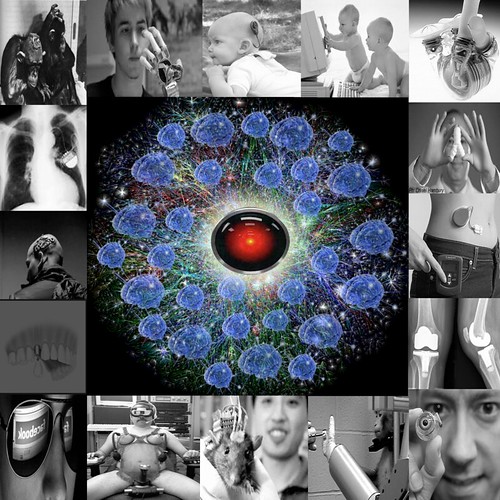
Or a high rez version here:
http://www.flickr.com/photos/danielgriffinnet/6235758794/
Flickr members feel free to comment there, or here, whichever you prefer. I’m still undecided on a title for this.. perhaps “We are the Web” might suit.
D
My perception of the lifestream is undergoing a constant change and as it is being felted to use a rhizome-related metaphor (Bayne, 2004). First I saw it as a mere aggregating tool. Thanks to Carol’s post, I saw it’s something richer than just a piece of software recording my online activity (like a kind of an electroencephalograph). Her reference to streaming as writing struck me initially as odd but having thought of it I can see parallels between the lifestream and an ‘extended text’. There is an underlying structure, vaguely shaped by the module themes and discussions and the seemingly chronological order of releasing the feeds into the stream with the most recent ones at the top; an element of striation? Simultaneously though, there is still room for ‘lines of flight’ in form of acts de/re-territorialisation, smoothness and unbounded liquidity as well as multimodality (various forms of communications – from shreds of informal conversations to more formal writings – and modes -from text through visuals to mash-ups . This rhisomatic take on the lifestream was taken even further by the subsequent comments made by Jen on the active role of the software in how the stream presents itself to the author (me) and the audience. There is an apparent diffusion of power over the meaning-creating process – ‘writing’ and ‘reading’ become more participatory, a positively disruptive experience, enhanced even more when you think of the technology being an agent and stakeholder in the process.

Lifestream Spiral
I am continuing to explore ideas in using my “Life Wall” for professional and academic purposes, such as presentation of a scientist’s thematic contributions and achievements. I have been testing out ways to describe professional life events as “Placemarks” described in KML and to add them to Google Earth or Google Maps.
An example on my Life Wall Pro version with some locations I have current profesdsional contacts with is at: View Life Wall Pro – Google Map Element
Some background to the XML used for KML Placeholders is here:
https://www.wiki.ed.ac.uk/display/Informatics/Google+Maps+Placeholder+in+KML
This is a mixed use and mixed institution educational area, with a number of plots used by a range of Universities, coverages and academic groups. There are a number of “classrooms in the sky” on various levels.
On arrival and initial exploration, the area is not well described or signposted. There is no obvious entry/arrival area and no note cards are offered. Looking round though it was clear there were specific institution and class areas set up for specific subjects. A veterinary studies area had sculptures of horses, and posters and displays related to horse anatomy for example. It had some nice teaching and presentation aids. There was a nice interactive “Artboard 2.1″ using prims for marked lines.
To find out more about the area and its uses, a Google search on “EduNation Second Life” leads to http://heyjude.wordpress.com/2007/02/05/edunation-secondlife/ which has next to no content and no one has posted comments… it’s full contents are:
The Consultants-E are proud to launch the first private island simulator in Second Life dedicated to online training seminars and conferences, and the use of Second Life in Education. EduNation is a 65,000m2 island in the Second Life virtual world with seminar, powerpoint, audio and videocast facilities. Use of the seminar facilities is free. More information at EduNation (http://www.theconsultants-e.com/edunation/edunation.asp)
That URL leads only to “Server Error – 404 – File or directory not found. The resource you are looking for might have been removed, had its name changed, or is temporarily unavailable.
This is rather typical of educational regions that are not well managed or owned by specific stake-holders. The area should be considered as one that lets people set up individual classrooms and areas and is not meant to have a cohesive design or allow for random exploration and discovery.
A good example of it in productive use by educators, and the reason I chose this region to explore, was a recent demonstration of a new version of the SLoodle module for the Moodle Victual Learning Environment. The demonstration organisers set up a new area well up in the sky and rafter landing at a simple initial meeting space, they dynamically rezzed large platforms nearby to show the facilities. and even rezzed a bridge to let the visitors walk over to that newly created facility. I attended a briefing about the new SLoodle 2 toolset on the EduNation III region of Second Life on Sunday 18-Sep-2011 by Paul Priebsch (avatar name: Fire Centaur). About 30 other educators were there. A feature of SLoodle 2 is the ability to set up “scenes” an rapidly rezz them in and around a classroom for a lesson, and then tidy them away so the ability can be re-used. This was demonstrated live on the EduNation regions. The SLoodle quiz chair can be set up to give rewards to students, or “penalise” them for failure… including dumping them in a shark filled pool with realistic screams!
A blog report of that demonstration is at http://holyroodpark.net/atate/weblog/6149.html. Full size versions of some images of the demo meeting are gathered at http://openvce.net/sloodle