Week 7: Some breathing space….


This week I was in the relaxed position of having posted my ethnography, partly because I misread the timetable and partly because I knew I wouldn’t have time to do much later on in the week. This meant that I could spend the week looking at others’ ethnographies and commenting, but also keeping an eye on anything relevant to my own ethnography. I added LibraryThing to my lifestream, although at the moment I’ve only added a few books that I have just/am currently reading so they’re not really relevant to the course, but it’s interesting to see how it could be used as a kind of community of readers. Previously I have used reading apps on Facebook as a way of recording and recommending reading to friends, but I will need to investigate the advantages of using LibraryThing further in academic terms as well as personal. I’m thinking about my blog and lifestream in the long-term as my line manager has asked that I investigate if it is possible to export content that I’ve generated during this course and extend it to become a regular blog that can be linked to our Learning and Teaching Centre site at Glasgow. The idea would be for me to carry on blogging and lifestreaming on issues to do with my job as an effective learning adviser, and also on e-learning issues.

There was interesting discussion this week surrounding our posted ethnographies. I found it particularly interesting, the way in which members of the course had chosen a variety of ways to present their ‘findings’, with, fittingly for the course, a fair amount of visual content as well as textual. It was also interesting, given the debate within the literature over what constitutes an (online) community (Rheingold 2000; Bell 2001 and Kozinets 2010), the variety of communities that my fellow course-members chose to study.  As opposed to Sardar (as quoted in Bell) who dismisses being a member of or posting to an online usergroup as not really constituting an identity, which might be argued as a community indicator, I was more interested in Bell’s discussion of a community being defined by its own members’ beliefs that they are a community, and by the notion of the affective as defining a group. Certainly, in my own ethnography, I felt that there was a feeling of community among the members and this came across in the other ethnographies posted. I did fine Rheingold’s rather ‘downhome’ version of community anathema to my own but this may be cultural with Rheingold referencing the homestead history of the US. A common theme in the ethnographies and discussion was the distance, or lack of, between ethnographer and the community studied (Hine 2000; Gatson and Zweerink 2004). Among us all, I think, there was a certain discomfort in finding our place as ethnographer, but there was good general discussion and, I think, consensus, on the need for a self-reflexive approach.

One of the ethnographies, Daniel’s on Diaspora, got me thinking about the political aspects of the course, from Hand’s views on the dystopian/utopian uses of the internet for political aims to some the possibilities for activism online, particularly in light of the Occupy movement and the role of digital culture in what is sometimes called a corporatocracy.

With the assignment looming large, perhaps this would be an interesting way to go, however, I am struggling to think about how this might include a learning-related focus. Alongside using my lifestream this week to think about our new theme of posthumanities, I’m going to explore some possibilities for the assignment.

Posted in Uncategorized | Comments Off

Week 8 is here….

Welcome to block 3 – time has gone quickly and this is our final course section.

The micro-ethnographies are coming together – still a couple to come but the majority are in and looking terrific. We suggest spending a few more days commenting on ones you may not have had a chance to see or discuss yet, alongside getting to grips with this week’s activities.

Block 3 is concerned with the over-arching theme of posthumanism, and we start with some readings aimed at orientation to this complex set of ideas. Hayles and Haraway are the classics, but you might do best to start with Pickering for an accessible introduction, if you’re unfamiliar with this area of thought. Either way, you’ll probably want to spend a lot of weeks 8 and 9 just reading and thinking as you work your way through some of these readings. You’ll find some discussion questions to help you – blog your thoughts if that seems appropriate and post a tweet when you have a blog post to share with the group.

When you’re ready, post your contribution(s) to our collaborative story of being posthuman in Wallwisher – you can do this anytime this week or next.

Please also feel free to invite a friend or colleague to class this week and next – if you know someone who would be interested in the material we’re covering over this fortnight, why not invite them to blog their own responses and tweet along with the class? Let us know who’s joining us in the comments on the ‘bring a friend to class‘ page.

Finally, remember to keep feeding your lifestream, and to write your weekly lifestream summaries.

Hope you enjoy the week!


Posted in Uncategorized | Comments Off

LifeStream Reflections Week 7 – Singers adopt YouTube

This week my lifestream has been centred on further exploring the phenomenom of the virtual choir. I have visited the VC FaceBook group and browsed testimonies of individual participants. One member Songuine sums up what she has gained form being a VC participant:

Through social media, I’ve been able to converse with a music professional who generously allows me access to his knowledge and his friends. I’ve been able to ask for advice and share in online music experiences with others.

From my isolated, lonely place on the planet, I’ve become part of a universal, ongoing musical event. My health might limit my physical journey, but broadband internet has opened the world to me. I’m amazed and blessed to be given this opportunity.

There seems to be a recurring theme of learning through self-reflection or gaining feedback from others. Matt Smith summarises his experience on FaceBook:

So what have I learned from doing this?

1) Seeing a video of myself singing has revealed some interesting traits about the way I sing which I did not realise I had. I am now doing my best to sort this out and improve.

2) Do not procrastinate. It’s not worth it. And next time (hoping that there is a next time) I will give myself enough time to do plenty of recordings so that I can pick the best one.

3) It is wonderfully refreshing to be able to engage and work with someone like Eric. He makes himself so available through the use of technology. I look forward to other artists of his stature following his example.

4) I will always be proud of being part of this project and will take great pleasure in telling people that I was a member of VC 2.0

The real high pint of the week was receiving a comment on last week’s blog post from someone not on this course! It prompted me to think of the VC as an extention of the ‘Choristers and Singers’ community of practice where the adoption of the YouTube commnunity norms of communication had enabled new interactions, relationships and emotional engagment to emerge through individual and group performance.

I have also been pondering the appropriate medium for presenting this small scale ethnography (which probably isn’t an ethnography at all!). A time line seems most appropriate and I finally settled on time toast as it is both easy to author and offers a clean user interface for the viewer. It is a shame that the free version limits the amount of text you can add to an event. I would have loved to have used a time line similar to the one depicting the series of events leading up to the Arab spring – pleasingly whooshy!!

I have finally got mobile uploads to my Flickr account working so have captured a few images of some of the Wesch presentation and a new book that I’m looking forward to exploring.

Here’s my ‘ethnography’ at long last!
I haven’t really been a participant observer here as a VC event is not currently taking place. I really don’t know if I would have enough courage to post my own rendition of one of the Eric Whitacre songs! I did think of making a youtube video of my investiagtion but time ran out so we have a time line instead.

Posted in Uncategorized | Comments Off

Playing at being an ethnographer

Designing the ethnography was a tough task and I spent a lot of time, perhaps too much, preparing for it and then writing it up. Towards the end I felt it grew out of proportions and somehow took over me, to an extent that I could not figure out how to put it into a coherent whole and how to present it. This is perhaps noticeable in the final design as well as lack of focus between the parts, especially ‘community’ and ‘ethnography’ bits.

I think no matter how objective I had meant to be, I did harbour some a priori assumptions throughout the project. I had problems deciding what ‘community’ means and whether it equals a personal learning network, a term usually used by the chat participants themselves. I quite liked the idea of Bund and thought it suited my purposes but I didn’t know how to relate it to the textual approach to ethnography and the focus on connectivity of texts, other than the sign of the participants’ passion and charisma. With the connectivity approach, it turned out that it is not only the chat but a number of other sites to explore, which would be a great idea but possibly beyond the scope of the project. I’m pleased with my prezi visualisation but I think the text-heavy bit on the community aspects introduced massive disproportion into the final product and affected its coherence. Focusing on the connectivity also meant change to ethical considerations – I am aware I should have got in touch with all the blog authors to ask them for consent to use fragments of their writing. The selection certainly fails to fairly represent the community – due to time constraints I went for blogs of people I know are active participants so hard to talk about randomness of choice.

observing .. them and myself too ...

pic from this site

Anyway, no matter how much I would like to work more on it, especially in terms of content and presentation, I cannot go on any more. Perhaps that was the thing I struggled with most – when to say stop! So unfinished and slightly untidy, here it comes! Voila!

To my virtual ethnography


Posted in virtual ethnogrpahy | Tagged , | Comments Off

Lifestream 6

Week 6 meant starting work on the ethnography and so the lifestream featured notes from the field and  bookmarks to related resources. However, for me it was still about visuality. The notion of a visual turn got deeply buried into my consciousness and although it’s still something I’m struggling with conceptually I cannot resist its appeal. I am continuously on the lookout for visual vs textual representations.

Through the links fed into my lifestream earlier, I have been led to beautiful visualisations of Kerouac’s On the road designed and drawn by Stefanie Posavec. The starting point was a rigorous analysis of the text for various syntactic and prosodic features, which then were transformed into intricate,  ginkgo-like patterns or more geometrical structures of entangled lines. The complexity of the visual mappings reflects the complex subject matter of the book, ‘a mysterious, semi-nomadic subculture dramatically at variance with the conformist and materialistic American culture of the 1950s’ (http://www.ontheroad.org/). Similarly to Sal and Dean who are in quest of God and Kerouac who is experimenting with the writing style, a few decades later Posavec seeks a different kind of truth and discovers it in her  innovative and aesthetically remarkable ways.

George Dyson (from another lifestream feed) repeats after Barricelli that we might not recognize life or intelligence when we saw it, because our definitions of what it takes to be alive or intelligent were so narrow. Perhaps the same could be said about the way we perceive representation. ‘On the map’ by Prosavec makes me think how much we are tied to textuality and how this inclination ingrained in us for centuries might narrow our perception of visual literacy.

Essay Visions

PS I wonder what my blog postings could look like or even the final essay -


Posted in lifestreammaries | Tagged , , | Comments Off

Summary: Week 7

This week my focus has been mostly directed towards the digital ethnographic study of the Diaspora community.  I freely admit that I have really enjoyed the study, but even more so, diving into this exciting new social network.  I see Diaspora as a potentially game changing development and hold high hopes for its success.  Other students comments on my work have also indicated that this is a subject that everyone has a profound interest in, but until now the tools to empower users haven’t been readily available or easy to use.  Hopefully Diaspora can fill the gap and help people to take some control back over the information that they put online.

I’ve spent allot of time thinking about issues relating to civil and technological liberties as well as the future implication of where we go from here.  One excellent discover this week has been BrainPrivacy’s collection of delicious stacks (lifestream 29.10.11, #2), which has produced much food for thought.  I’ve also been examining social networks in general and how they relate to this subject.  Facebook’s new Timeline feature (lifestream 29.10.11, #3) looks like a great way to share information, but still suffers from the same problems of data ownership and poor privacy inherent to the platform (lifestream 01.11.11, #3).  A telling example of this problem is the policy change put in place by the Ning network some years ago.  At its inception, Ning offered a free social networking service which could be branded and tailored as the user saw fit.  This popular service was the platform of choice for many small online groups however Ning changed its policy to include an ownership charge, thereby locking out many users  (including my local MargaretStreetMassive group (lifestream 01.11.11, #2)) and thus preventing them from being able to retrieve their data.

The rest of the week was devoted collating literature for the ethnographic study as well as commenting on other students work.  There have been some really interesting studies across a wide range of subjects, offering much to think about.  In short, a great week!


Posted in ELearning and Digital Culture, Hacking, Social Networks | Tagged , , | Comments Off

Ethnography

Reasons for my choice

This story starts with the reason I have chosen the science bloggers group for this ethnography. I am not a joiner of groups, in fact the only membership I have is with TES, so I did some searching and head-scratching to find one.  It was on reading Jen’s comments on the Holyrood Hub that this task should be enjoyable that I finally made my decision.  I enjoy reading science blogs and have an RSS feed from the Female Science Professor to my Lifestream. When reading the FSPs blog I would see interesting links to bloggers she follows. This in turn would lead me to follow links to bloggers they follow and so on.

The ethnography will be formed from observation and exploring ‘…the social spaces of the Internet’ (Hine 2000);  participating ‘covertly in people’s daily lives for an extended period of time, watching what happens, listening to what is said, asking questions’ (Hammersley and Atkinson quoted in Hine).  Data has been collected from various blogs over a short period of time so at best the results will give a snapshot of life in the science bloggers’ community.  The information used in this research is available publicly from bloggers sites; there has been no violation of trust. Each blogger gives a brief description of themselves and their field of work, though not in any great detail.  The fields range from physiology, pharmacology, biomedical research, neurosciences and teaching to science journalism.  This is by no means a comprehensive list.

Could science bloggers be said to belong to an online community?  Shared interest may seem a tenuous connection to base this ethnography, bearing in mind the diverse fields of science.

Study Questions

My study questions are:

  • Are Science Bloggers a community?
  • Do users support each other?
  • How do users relate to each other?

Are Science Bloggers a community?

No membership is required to join this group. Participants are world-wide and either work in a science related field or have a general interest in science.  One blogger actually asked readers to say who they are, if they have a background in science and what draws them to the blog.  At last count, there were 47 responses.  There are no written rules, participants tend to follow the social code of good manners.  No ‘one’ person is in charge but the voice of reason tends to rein in transgressors. For example,  a blog about attending meetings whilst on maternity leave  resulted in a few ‘husband bashing’ responses which were quelled by postings pointing out that this was not helpful. The group discuss various topics, newsworthy articles and critique work. Bell (2011) states “communities are imagined and held together by shared cultural practice”.  In this respect then Science Bloggers can be termed a community.

Do users support each other?

Kozinets poses the question, “How deep, long-lasting, meaningful, and intense are those relationships?”  This group are very supportive, give very good advice and follow career paths wit interest.   A blogger asking for advice on writing a CV and tips on questions to ask, or that may be asked, at interviews, received a number of responses. Advice requested is usually met with quick responses. Helping raise funds for schools shows they have a sense of responsibility which transpires the group.   A blog about an exchange between the blogger and a Press Officer who advised, “I think you have all you need for a blog” received a lot of responses and tweets.  Support for the blogger showed a strong sense of loyalty from the community. In fact, the way they dealt with this they could be described as a ‘Bund’ (Bell).  As in any community, some members form closer attachments than others.

How do users relate to each other?

The group takes a personal as well as personal interest in their community.  They share thoughts and ideas;  tell stories about their pets; share stories of trips and concerts;  give cooking tips, menu ideas, cocktail recipes also book recommendations..  They talk about moving house, changing jobs, concerns at work – they share their lives.    There is an obvious sense of friendship, and humour,  as evidenced by the calaveras.  Some blogs and responses are serious and some are tongue in cheek; read Colin’s response to breastfeeding in public.

Conclusion

Knowing the personality of an individual helps to understand the person  and so to it is with understanding of a community.  The culture of the science blogger community can be termed as a ‘barn raising’ community.  This virtual community “ ..chat and argue, engage in intellectual intercourse.. exchange knowledge, share emotional support, make plans..“ (Rheingold quoted in Hine).

“An online community is a community if participants imagine themselves as a community” (Baym quoted in Bell).  This group definitely see themselves as a community and I do too.


*Please also see Prezi presentation.

Bibliography

Bell, David (2001) Community and cyberculture, chapter 5 of An introduction to cybercultures. Abingdon: Routledge. pp92-112.

Gatson, Sarah N. and Zweerink, Amanda, (2004) Qualitative “Ethnography Online: ‘Natives’ Practising and Inscribing Community” Research 2004; 4; 179

Hine, Christine (2000) The virtual objects of ethnography, chapter 3 of Virtual ethnography. London: Sage. pp41-66

Kozinets, Robert V., (2010) “Understanding Culture Online” from Kozinets, Robert V., Netnography : doing ethnographic research online pp.21-40, London: Sage


Some Web addresses

http://blogs.scientificamerican.com/network-central/about.php?author=11

http://dr-becca.blogspot.com/2010/12/11th-hour-pre-interview-freak-out.html#comments

http://embargowatch.wordpress.com/2011/02/14/how-to-demonstrate-youre-not-about-transparency-and-piss-off-reporters-as-a-pio/#comment-1527

http://embargowatch.wordpress.com/2011/02/16/update-on-aeron-haworth-and-ed-yong-an-apology-accepted/

http://scientopia.org/blogs/drugmonkey

http://isisthescientist.com/2011/10/26/when-does-breastfeeding-become-offensive/#comments

http://physioprof.wordpress.com/about-physioprof/

http://scientopia.org/blogs/proflikesubstance/

http://www.theenlightenedpio.com/2011/02/outing-poor-press-officer-work/

http://scientopia.org/blogs/bridgeblog/2011/11/02/calaveras-2-0/

http://silent-typewriter.com/


Posted in Uncategorized | Tagged | Comments Off

Mini Digital Ethnographic Study: Diaspora

Introduction

Diaspora is a distributed social network running on a collection of open source personal webservers across the Internet.  Diaspora is a community of passionate users who control their own data, control who sees it and who can harvest it. Diaspora is a project that I have been observing from a distance since the announcement by four NYU college students in 2010 that they wanted to to build a Freedom Box and make a step towards changing how we use social networks.  Diaspora used crowdsourced funding via KickStarter to raise over $200,000 which allowed the developers the financial stability to dedicate themselves to the project.  Diaspora is free (“as in freedom”).

In this brief ethnographic study of the Diaspora community, I have employed a combination of participant observation and direct interaction with users in order to better understand the community and its members.  I have posted questions to the community and received a considerable volume of responses given my status as a new (and consequently unconnected) member.  I have attempted to define what it means to be a Diaspora member and what it is that drives people to join the community.


Ethical Issues

Given that Diaspora provides the potential to limit who sees the information that you choose to share, I  have avoided using any user posts or data that came from private sources and have opted instead to publish only data that is specifically marked as being public.  Data produced with digital publishing tools simplifies any ethical decisions for an ethnographer but does not remove the responsibility to always consider any possible, wider implications of material that is published.  With this in mind I have chosen to anonymize any users data and avoid direct quotation where possible.  Any user names or avatars that appear in graphics have been blurred to further protect the identities of those involved.


Background

In researching the nascent Diaspora community prior to joining, I became aware of a strong sense that the development team considers this project to be something of a social movement rather than a mere social network.  Co-founding developer Daniel Grippi uses the phrase “a spark to start a fire” in the second video below.  This language sounds highly politicized and obviously hopeful for great things to come.  Since joining I have frequently noticed this same sentiment from Diaspora members themselves and must confess that I hold similar views and aspirations for the success of such a movement.  Hine tells us that “ethnography is appealing for its depth of description and its lack of reliance on apriori hypotheses”, (Hine C. 2000. “The virtual objects of ethnography”).   My sentiments therefore have caused me some difficulty in remaining fully objective in my research, and it is something that I have been continually conscious of and careful to avoid.  That said, the initial motivation for the development of Diaspora is indeed based on a politicized view that users have rights and are not just a product to be sold to marketing companies.  Diaspora adheres to the Computers, Freedom, and Privacy’s Social Network Users’ Bill of Rights.  Its very beginnings are inspired by Columbia University law professor Eben Moglens now famous lecture “Freedom in The Cloud’, first presented at NYU in early 2010 in which he describes centralized social networks as offering “spying for free” (from Wikipedia).  The projects main tenants of Choice, Ownership and Simplicity (see home page on https://joindiaspora.com/) serve to empower its users in a manor unheard of amongst profit driven social networks.  The following videos are what I believe to be key points in the emergence of Diaspora and what I hope will be a new movement for user empowerment online.

  • Eben Moglen’s “Freedom in The Cloud’ presentation at NYU Feb 5 2010.  In this lecture Moglen introduces his concept of the Freedom Box, a device like a personal webserver that allows the consumption of network services without the traditional dangers.  This lecture has a profound affect on the Diaspora founding members.

    http://www.youtube.com/watch?v=QOEMv0S8AcA


Arrival Story

Taking the title of the introduction to Gatson and Zweerinks paper “Ethnography online: ‘natives’ practicing and inscribing community” to heart, i.e. that there there is “no such thing as non-participant observation”, I decided that the best approach would be to create a new account and dive right into the community as any newcomer would.  I posted the Diasporian equivalent of “Hello World” to my stream and announced ‘Hi, I’m #newhere’.  The use of this hashtag is something of a debut for new members, an announcement that they are ready to participate, meet and interact with others and begin to the form bonds that will connect them to the community.  I’ve speculated during this course that because of the ease involved in joining a virtual community, the traditional ethnographic arrival is less meaningful until the active creation of “connections” (ie friendships, followings or any one of the many terms used by social networking sites) occurs.  The following Flickr set shows this process as a series of steps.  It is in a sense my own arrival into the community and the beginnings of my real membership.  In the spirit of the community, these images are released under a Creative Commons, Attribution license.  The wordpress instance on which this blog post is written does not allow the insertion of iframe or embed code, but you can see a slide show of the set here:

http://www.flickr.com/photos/danielgriffinnet/sets/72157628030760816/show/

Or a direct link (useful for viewing annotations and commenting) here:

http://www.flickr.com/photos/danielgriffinnet/sets/72157628030760816


What is a community?  Is Diaspora a Community?

During the course of the last two weeks we have been discussing the notion of community and how it relates to groups of people whose primary method of communication is digital.  Indeed we have questioned whether such groups are indeed communities at all or whether they are simply loose collectives of people gathering around a common focus.

In his book The Virtual Community, Howard Rheingold references graduate student Marc A Smiths work on the concept of collective goods as a useful tool to determine whether a particular group constitutes a community.  “Every cooperative group of people exists in the face of a competitive world because that group of people recognizes there is something valuable that they can gain only by banding together. Looking for a group’s collective goods is a way of looking for the elements that bind isolated individuals into a community”, (Rheingold, 1993).  Smith proposes that the collective goods which create a community are social network capital, knowledge capital, and communion.  When I first read this quote I became very excited because although I have only recently become a Diaspora member, I have already encountered or observed these phenomena at work.  From its very inception, Diaspora has been a group based not around some minor theme or activity (not to say that such groups cannot themselves be considered communities), but rather focuses on a momentousness and potentially paradigm shifting goal, to empower the user and move control of the network away from traditional structures.  In this sense it is a textbook example of a gemeinschaft community.  Its members are generally technologically savvy and seem to be willing to help or offer advice readily to new members.  In my “#newhere” introduction, I asked the community what it is that interests them most about Diaspora.  Obviously the reach of such a question is fairly limited given my new arrival and the very small number of connections that I had, however the question did produce several interesting responses from other members.  Almost every answer that I received focused to some degree on the facts stated in Diaspora member David McCauly’s now widely circulated Dozen Reasons to Switch to Diaspora.  The typical user (in my experience) is well informed and interested in subjects related to the Free Libre Open Source Software development movement.  They have found a place online which cherishes and strictly upholds these values.  In their fellow members they may see many traits that they recognize within themselves, and from this there quickly grows a sense of connection, or the emergence of a shared communal identity.  One user response to my post was particularly succinct, giving the following reasons paraphrased here: it is non-commercial, open source, protects privacy and has some pretty interesting people.


Conclusion

Given my personal interest in the subject matter, I have attempted to remain as unbiased as possible during the course of this study; however my findings do indeed appear to echo my preconceptions.  The Diaspora community is composed of many unique individuals, all of whom are connected through their passion for social freedom and personal empowerment.  They are for the most part highly technically literate and vocal on subjects relating to the use and misuse of technology.  As a group, they represent and share the ideological viewpoint that it is not only possible, but essential that we “provide privacy in normal life, and safe communications for people seeking to preserve their freedom in oppressive regimes”, (http://www.freedomboxfoundation.org/).  Again I am reminded that an ethnographer should attempt to ignore any preconceived notions and to remain as objective as possible, however I must admit to identifying strongly with these statements and to holding very similar views myself; perhaps I too have found a new home online…


References

Diaspora Foundation Homepage http://diasporafoundation.org/

Hine, C. (2000)  The virtual objects of ethnography.

Rheingold, H. (1993)  The Virtual Community.  (online, retrieved 01.11.11)
http://www.rheingold.com/vc/book/intro.html

Gatson, S and Zweerink, A. (2004) Ethnography online: ‘natives’ practising and inscribing community.

Wikipedia Diaspora page, (retrieved 01.11.2011) 

http://en.wikipedia.org/wiki/Diaspora_%28software%29

Posted in digital literacy, ELearning and Digital Culture, Social Networks | Tagged , | Comments Off

Lifestream Week 7

The EDC11 ethnographic study was completed over the weekend, and provided to allow comments by others on 31st October. It was very interesting to see the other studies as they slowly became available… and I commented on those where I had some inputs to give.

batIt was also Halloween of course, so I could not resist a post or two that brought in my user name “bat”, one of my avatar outfits for Halloween provided to me last year in fact and a chance to wear it again, and a funny reference that came up as we had “Zombie” processes plaguing our Moodle service.

Good progress has been made in the last week on setting up a Moodle 2.1.2 (latest version) VLE for tests and connecting it via the SLoodle toolkit to a classroom in Second Life. Feedback is being given to the SLoodle development community as they move the current test systems from alpha code status to a first beta version that will work with Moodle 2.x versions. My Lifestream indicated a flurry of activity on this testing and interaction with the communities involved.

I was surprised that my Lifestream seemed to have a low number of events on a couple of days when I seemed to be very active on-line, and in areas I believed I had feeds in place. It turns out that all WallWisher feeds I have in place only received a single event, for the very first posting on each of my walls, and none since. Its not clear why. The event itself though is meaningless anyway as it does not contain the useful text posted on a WallWisher entry label, and the pointer does not go to the content of the entry, but just generically to the wall itself. As a snapshot today for my own walls (15+1+14) and some contributions to IDEL11 (2), EDC11 (3), and a new EDC11 “Post Human” (2) wall I have a total of 37 WallWisher “events” to date only a few of which show in my LifeStream unfortunately. [Mentioned at the suggestion of Jen Ross purely for assessment reasons :-) ]

Only showing as a few hints in my on-line activity at present (deliberately) is a concept I am developing for work on “Another Planet”. This involves some new concepts I am developing with an exploration of a non-linear “Neo-Grammar” that uses a visual and typographical style with hyperlinks to present “Connectors”. A Wall Wisher wall that already contains 15 or so entries (not showing in my Lifestream) is being created in support of this experiment. More coming in next few weeks on this.

<Connector> ::= Token ⊃—⊂ Token

Finally, I set up a “Personal Learning Environment” web area and entry web page that brings together a lot of the scattered entry points, summary links pages and shortcuts I have to reach web sites, blogs, discussion forums, WallWisher walls, VLEs, etc for the MSc in e-Learning courses, as well as pointers to my own assignment contributions. Initially I created this as part of exploring VLEs vs. PLEs for the IDEL11 course, but it has quickly turned into my single point of entry at work, at home and on mobile devices for access to my educational resources and work areas. Since I cannot resist looking ahead, I also have the EDC11 “Post-Human” WallWisher board embedded on the page at present. This is a good example of how a PLE can reflect current focus for an individual learner. A more controlled VLE approach would definitely not have focused something for the following week on its front page. I have refined the style sheets a little to give a simple flexible width style that gives a maximum view of the core content and works well on a range of browsers and devices with large and small (e.g. mobile device) screens. This work space is at http://atate.org/space/.

Posted in EDC11 | Tagged , | Comments Off

LifeStream Reflections Week 6 – It is a community, is it networked learning, is it a GME?

This week, through the artefacts encountered in my life stream I have been thinking about the extent to which the Virtual Choir constitutes a community.

Engagement with the choir centres around a single online event or performance on YouTube. The ‘community’ is for the most part located on YouTube but participant interactions are very different to a typical YouTube community as described by Wesch in his YouTube ethnography. Although participation is via webcams and screens as in other Youtube communities, in the virtual choir individual participant videos are primarily about offering a prescriptive performance as an audition piece for the choir. Therefore the virtual choir participants can make an informed guess about their audience and the context in which it will be viewed, unlike regular youtube participants where these are typically unknown. As Wesch points out most youtube participants experience ‘context collapse’ i.e. they do not know who their audience is, when they will be watching or even if they will be watching the original or a remixed version. A ‘hyper self awareness’ that Wesch claims develops when recording and broadcasting yourself via youtube might be seen as particularly beneficial for the Virtual Choristers as they are able to review their performances and improve them. However the overt authenticity of the virtual choir participants sets them apart from many youtube participants who are often playful around their identity such that it is difficult to decide what is ‘real’ and what is ‘enacted’.

In a recent Networked Learning Conference 2011 ‘hot seat’ discussion lead by Peter Goodyear a question was raised about whether the virtual choir represented networked learning. Jenny Mackness discusses this in her blog post. I found the reference to an ‘imagined community’ quite apposite especially in the light of Wesch’s comment about an increase in individualism leading to greater desire for community. As Jenny points out many of the virtual choir participants had at some time been part of a ‘real choir’ and their virtual participation seemed to awaken nostalgic memories of the collective experience of singing in a choir. It seems to me that participation in the virtual choir did provide many opportunities for individuals to learn about and improve their own performances through receiving guidance in interpretation from a leading composer/conductor and having the opportunity to review and refine them in the light of feedback and encouragement from other participants. In some sense this collection of solo performances may be considered more demanding for the individual than participation in a synchronous group performance.

This idea lead me to the final part of my journey this week, that is exploring the concept of a Global Media Event in relation to the virtual choir. Ribes define a GME as

“a special type of cyclical contemporary event, naturally global, naturally mediated through new technologies, which produce their own emotional climate and emotional dynamics, and have at its core certain spectacular collective ritual performances.”

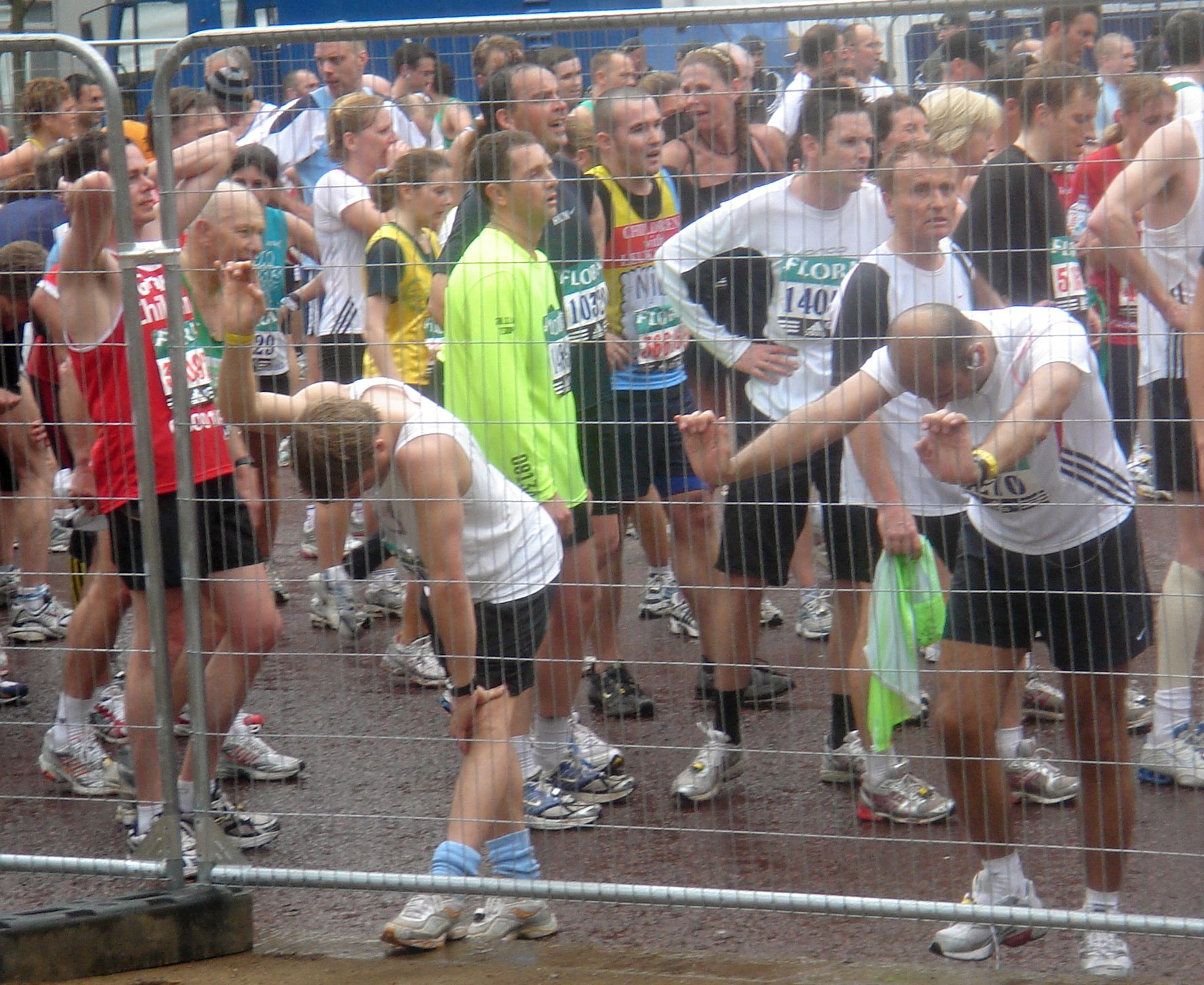
I reflected on other instances of collective individual performances which led me to large scale sporting events e.g. The Vasaloppet and the London Marathon.


There seemed to me to be many similarities between the virtual choir and these face to face events. They are first and foremost about individual performance but the event seems also to engender a sense of connection with other like minded participants through a collective experience of participation – perhaps another instance of imagined community? There is also an element of competition associated with the virtual choir participant performances as they are hoping to be selected for a place in the choir event.

This week my lifestream has been largely focussed around exploring the virtual choir. I mostly rely on Diigo bookmarking but have been trying to use Tumblr more as it looks quite useful for capturing quotes.

Posted in Uncategorized | Comments Off