Another Planet

I have been cooking up another project…. the appeal of utopian “Other Worlds” and projecting identities into them (see Gee, 2003). The creative experience of imagineering such a world, making it plausible and “real”, and inhabiting it in a social context is something I want to explore more. I am initially building some images related to this on Wall Wisher…
http://www.wallwisher.com/wall/another-planet

Gee, J. (2003) Learning and identity: What does it mean to be a half-elf? What video games have to teach us about language and literacy. New York: Palgrave Macmillan.

Posted in EDC11 | Comments Off

Week 6: Magpie lifestream

It’s been a strange week in my lifestream. Last week was very much focused on finding information on ethnography and on online communities, with an emphasis, once I had decided to look at Mumsnet, on all things woman and blogging/chatting. This week though has been one of magpie activity…the collecting of shiny things! I’ve continued to look at Mumsnet and other sites, but I didn’t want to stream any comments from chat into my lifestream as, although the chat is public, I felt it was intrusive to stream personal conversations into my blog. And so I began collecting shiny things – anything that attracted me to it and that I wanted to keep. I had been inspired by Neil’s project the week before to record all his activity online rather than to just focus on anything relevant to the course. I’m not sure I quite did that, but I did decide to stream anything that was more broadly relevant to the course, rather than just on this block’s focus.

Most of these ‘shiny things’ have been collected through Stumbleupon which, as I said last week, appealed to my sense of the random. However, it also got me thinking about what digital culture is and provides us with. If there is the opportunity for community, as we have been considering the last few weeks, or, as Bell points out, the threat of destroying what little RL community we have left, what does the vastness of the internet leave us feeling. If the internet represents an opportunity to experience and connect with, not just other people and cultures, but also a new kind of (digital) culture, then does its vastness and speed of change and usage –

http://www.stumbleupon.com/su/7iJEVG/www.go-gulf.com/60seconds.jpg

mean that I am just as limited in my ability to experience it as I am by my ability to experience the physical world? The ability to explore (money aside!) is dictated by knowledge. If I do not know what to look for, then how do I find something? I think Stumbleupon is useful for this but obviously has its own limits – I found a lot of sites it took me to were entertaining but, ultimately, nothing more. One site – http://www.makeuseof.com/ - had some practical information but it’s section on ‘geeky fun’ was a looming black hole that it was easy to fall into and, ultimately, procrastinate over.

On a more serious note, I find myself streaming a fair amount from the Guardian such as the article on social media censorship in China. This spoke to issues of online communities as the Communist party struggles with the ‘growing boldness of microblog users’ . Having experienced the lack of social media in China on a trip last year, I found it, at first, very strange to be unable to keep in touch on Facebook. Within a day or two though of trying to go through proxy servers (blocked) I became entirely unconcerned. However, the issue is not whether the loss of Facebook is really an infringement of freedom (one can feel quite ‘freed’ without it) but where censorship might be used to quash community discussion and activism – this took me back to thinking about Hand in week one and his discussion of the utopian/dystopian and the political use of Web 2.0, and to what freedoms digital culture might afford us. Perhaps we often confuse choice with freedom.

Posted in Uncategorized | Comments Off

GA-MMA Virtual Ethnography

My ethnographic study was of the GA-MMA group… the Gerry Anderson Model Makers’ Alliance. The study is at:

http://atate.org/mscel/ethno/

Please leave any comments here.

Posted in EDC11 | Tagged , | Comments Off

Ethnography Week – welcome to week 7

hi everyone, and a big welcome to week 7! This week we’ll have a chance to admire and discuss the fruits of your efforts over the past few weeks as you’ve developed your ‘micro-ethnography’, exploring the concepts raised in the readings from this block and your own investigations on the web.

The list of ethnographies is here – add a comment with a link to your own when you’re ready to share it.

Try to make sure to leave some time this week for engaging with others’ work, and commenting on it as well.

Have a great week!

Posted in Weekly Welcomes | Comments Off

B(at), Be, … Z…

It’s Halloween from bat, from AT, and this time its not Ai but from Be… and what’s that about Z? See the Holyrood Park blog entry.

Posted in EDC11 | Tagged , | Comments Off

Week 6 Summary

Hands writing on the ‘Circulation, Networking [and] Flattening’ came to mind this week and can be related to a virtual community. My chosen community is brought together by the belief that the members are equipped with political, moral and spiritual ideologies that can better the world and make it sustainable. As Hand says, cyberspace reduces the limitations of being a lone, lost voice by enabling people that are geographically distant to join together to form a larger, empowered body of people. The possibilities of the cyberculture restructuring boundaries created by a democratic world tied up in bureaucracy are intriguing. I also hold some cynicism that people can hide behind a persona that is not representative of them in the ‘real world’. This is something I wish to investigate further.
Much of this week has been spent observing the multi-faceted dimensions of my community and taking snap shots of what I feel represents the community. Ethically, I feel I have addressed the essential thinking related to being the ethnographer (as outlined on the AoIR website and course content). However, as I become more acquainted with the community I cannot help but make personal assumptions and question whether I agree with/support their practices. For my participation within the community my participation is not guided directly by the literature but something that I am personally, morally comfortable with. I’d go as far as to suggest that whilst my ethnography is conducted with a benevolent attitude I find myself repeatedly questioning whether in fact I may interfere and inadvertently alter the natural dynamics of the community. Undoubtedly, I have found this aspect the most challenging part of ethnography and have therefore decided not to contribute but attempt to make unbiased observations.

Posted in Weekly blogs | Comments Off

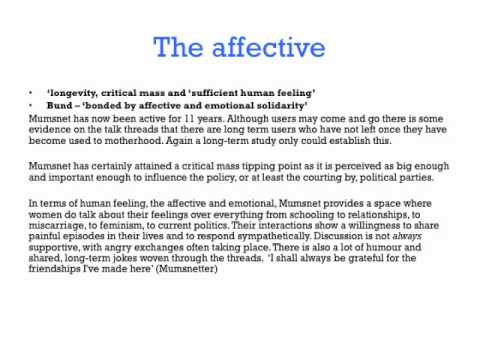
Mumsnet ethnography

I really struggled to upload this ethnography as it was originally in powerpoint and slideshare wouldn’t accept it. Have uploaded as a movie to youtube but, unfortunately it’s lost its soundtrack. Just imagine the theme to Charlie’s Angels in the first few slides and I’ll try and fix tomorrow!

YouTube Preview Image
Posted in Uncategorized | Comments Off

Summary: Week 6

Its hard to believe that we are already half way through the term.  The life stream is a great way to review my journey through the course content and I really have the feeling that the content I’m pushing into it is becoming more focused each week.  This week I continued my arrival story into the Diaspora network.  In last weeks post I speculated that the arrival into a social network is more about making connections than something as simple as account creation, and I’ve definitely made some very interesting connections thus far.  Of course my interactions are filtered by the hashtags that I’m following, and no doubt there exist other groups who follow different ideas within the overall Diaspora network.  Indeed, since each user chooses to follow their own personal set of hastags, each belongs to an overlapping set of interest groups.  But I still get the feeling that there is a common shared identity amongst Diaspora members, an identity characterised by politically and socially motivated (lifestream 26.10.11 #4), technically literate and (from my perspective at least), interesting people.  The excellent quote in Bardzell & Odom (lifestream 24.10.11 #5) reminded me that if one member of a group likes film trivia while another prefers astronomy, any sharing that takes place between them is more meaningful that the actual content being shared.

As an aside to my own arrival story, I wanted to get a picture of Diasporas own arrival story (ie its inception) for use in my ethnography.  The motivation to build the network followed Eben Moglens excellent Freedom in the Cloud lecture (lifestream #2, 21.10.11), something that also affected me very deeply on my first viewing.  I also collected some other videos (lifestream #2, 21.10.11) on this subject as well as one interesting competitor.

Immersing myself in technical subjects and conversing with technical Diaspora members prompted me to do a little investigation of the software underlying the technology.  This introduced me to Collaboration Graphs and the game, Six Degrees of Kevin Bacon (lifestream 24.10.11 #2) which reminds us that the real power of social networks and graph databases is the uncovering of connections we never imagined existing before.

Posted in ELearning and Digital Culture, Miscellaneous Techno Babble, Social Networks | Tagged , , | Comments Off

Week 6 Summary

The focus this week has been on data collection, some of which I had hoped to add to my feeds, and to giving some thought to the choice of media I’d like to use to present my ethnography.  My plan was to keep it succinct but the more information I gather the bigger it’s becoming.  At the moment I feel like I’m walking along a corridor that goes on and on.

Like one of my colleagues, I have also had to spend some time doing a little Lifestream ‘troubleshooting’.  I have no idea why some feeds are causing me problems but it’s clear the problems have to be remedied. My Tumblr account seemed to have ‘frozen’ on me and I decided it was easier to open a new one than to work on a resolution.  I have tried and tested the new account out; it appears to be working fine.   Delicious and Flickr are still causing problems.  Clearing the error log is my way of handling it at the moment.  I’ve bookmarked a couple of articles to my Diigo account and they are thankfully showing up in my Lifestream.  As I wasn’t able to use YouTube for the visual artefact task I have opened a Vimeo account.  I just may want to use this media for the ethnography task.

We’re now half way through the course and my Lifestream is starting to take shape, I think.  It’s certainly looking busier.  One of my colleagues commented that this is not a true reflection of how his time is spent online.  I too get carried away checking out links colleagues have tweeted, or finding something interesting in one article that leads me to another, and another.  And I am still wary about what I say and do, knowing that this can be viewed publicly.  I actually ‘googled’ my name to check what does show up.  An on-line diary does appeal to me but with restricted access.


Posted in Uncategorized | Tagged | Comments Off

Lifestream Week 6

There was an excuse provided by the subject of study on IDEL11 in the last week to look at a “Personal Learning Environment (PLE)”, e-Portfolios like “PebblePad” and “Virtual Learning Environments (VLEs)” like WebCT/Blackboard and Moodle. This was actually quite timely as I was getting concerned that the volume of assets I was creating for the course was getting scattered across the very many social media sites used on various courses, was being locked into the WebCT walled garden for each module, or was being scattered across my own preferred blogging and information sharing sites like OpenVCE.net. I had had an entry page for useful and quick access links for the course at http://openvce.net/mscel since the semester started, but it was inappropriate to personalise that public facing web page too much. I also was starting to build image repositories in my own personal web area at http://atate.org.

So, I have now created a “Personal Work Space” which is acting as a PLE for now, but after the MSc it will be made more generally useful for my continuing life long learning and asset storage at stable URLs. This could be timely as I am within 5 years of likely retirement, and many of the assets I have built over the last 30 years will be ones I want to take into retirement for my continuing interests. I took the opportunity to put in place a new page format and underlying CSS stylesheet that would work more flexibly than my usual project spaces. It accommodates browser width much better, is easier to add content reliably without changing the appearance as my previous tabular layouts tended to, it works in multiple browsers, and it works well in very small windows and on mobile devices. It also uses only simple and standard CSS and uses no Javascript. I moved all the convenient links and a set of useful embedded elements like a course twitter feed as well.

The initial result is at http://atate.org/space/.

There was quite a flurry of activity in my blogs and hence my lifestream this week related to Moodle and the Second Life link up via the SLoodle module and in world classroom object “rezzer”. An updated web/PHP platform to let Moodle 2.1.2 (the latest version) run on one of our servers was put in place last week allowing proper experiments to begin. There is a SLoodle classroom on the VCE region of Second Life and I am blogging and tweeting to the SLoodle community about progress in testing. There are some small issues that are being addressed in the “alpha” grade code currently under review. It is a good time to give feedback to the SLoodle community as they are close to trying to create the first “beta” version of the Moodle module that will be able to run with the latest Moodle 2 versions. My PhD student, Punyanuch Borwarnginn, who is working on Intelligent Learning Environments also has a course set up. She also has her own I-Room/Classroom space on Vue North in Second Life, and is now a course creator in our Moodle system. See http://openvce.net/ile .

There was a flurry of lifestream events related to my completion of a “learning challenge” for the ULOE11 course. This was a fun challenge to learn one of the skills taught to junior hairdressers. I took this seriously and probably went a bit over the top with the effort put in on it. But it was very enjoyable, and I am pleased with the results. The lifestream events show my various blog postings as I went along. See http://atate.org/mscel/hair/ for a summary of the whole show. I have created a colour printable version to provide back to the good people at the hairdressing salon who helped me.

I notice that a lot of my activity on the “Digital Cultures” course does not appear in my lifestream as much of the discussion is now on a non-public Discussion Forum. The ethnography study also involves personal analysis of the corpus of messages from my virtual community… GA-MMA. The emerging results are being created at http://atate.org/mscel/ethno/.

Finally, this week we also heard that John McCarthy had died. He was a pioneer of AI, and the one who coined that term. He was a great visionary too. I made several postings and tweets about his life, and gave pointers to his fun and perceptive short story… “The Robot and the Baby”.

Posted in EDC11 | Tagged , | Comments Off