Weeks 3 and 4

Focus was on making connections between cyberculture and visual literacies. A Skype text chat was organised during Week 3 to discuss the effects these have on educational thinking and practice.  “Skype, however, is banned in the UAE and its website, www.skype.com, is blocked by authorities.” (Gulf News). It is a very strange phenomenon that although Skype is banned, this media is actually used in IT courses in colleges. As I already had an account I added Sian, Jen and Jeremy to my contact list, having every intention of taking part but 11pm my time was too late, especially as I had a very early start in the morning. I found I couldn’t stay awake.


The culmination of readings is presentation of a visual artefact. In preparation I searched for images and tried saving them in my Flickr account and bookmarked interesting sites.  However, my Lifestream is showing a number of errors

which are caused by my Flickr and Delicious accounts.  I made an attempt at trying to fix them but was unsuccessful.  Workload is heavy at the moment, I now spend 5 hours a day driving, and as there’s no Internet at the schools I have to work when I get home.  This gives me a limited number of hours in which to study so I can’t spend too much time on fixing problems like this.

I thought about using Prezi for my visual artefact.  My idea was to use the 10 tentacles (arms?) of a squid relating to  cyberculture, communication,AI, VR, cyberpunk, computers, education, medicine, government control and man vs machine. The squid was a metaphor for the many uses of technology and how, because of the slipperiness of the tentacles, it could all quite easily slip out of our grasp. Unfortunately, we were having problems with Internet access in this part of the world (which may have been due to storms) but trying to load the application proved too time-consuming.  This was also true of Glogster and YouTube (though there was an added problem with YouTube which I’ve already mentioned).   My theme changed each time to fit the media.  I eventually tried Tumblr and had to limit the number of images.   Even so I had to make several attempts before completing the task. To be able to say more, but use less, I made use of the mandala and tree of life pics.

My visual artefact didn’t depict Thomas’s transliteracy – no sound or text,  I only made use of image.  Nor was I able to incorporate Bayne’s ‘uncanny’ or ‘ghostliness’ which lends itself to imagery.  My visual aretefact wasn’t what I envisaged in my head but as Kress states, “… the emphasis in multimodal work is very much on the materiality of the resources for representation”.


Posted in Uncategorized | Tagged , , | Comments Off

Week four: The eye of the beholder…..


The latter half of week 4 has been taken up with the posting of and commenting on our visual artefacts. What has become clear, if it wasn’t before, is just how much a visual representation of any kind is not, as Kress (2005) suggested, a specific symbol, but has as much interpretation involved in its ‘reading’ as do written texts (if not more). As Rose (2007) convincingly argues, the images of the world that are rendered visually are ‘never innocent. These images are never transparent windows onto the world’ (2).  The use of the word windows is an interesting one, I think, as it makes me think of the way in which our eyes/minds are considered as receivers of images, with all the implications of perception running from, for example, a physical, and passive, reception of images via the eye (Locke et al) to that which we see as constructs of the mind (Berkeley). As with previous weeks on this course, the themes of relation between the signifier and signified (whether word or image) and of authenticity are raised by considering perception. What is the relation between how we see and how we think? Rose’s paper (2007) provides a really good framework at least for starting to think of how images are produced and viewed and reinforces that intention, interpretation and cultural/social contexts and constructions all combine to inform how we view an image. I particularly like Rose’s categories of ‘the site of production’, ‘the site of the image’ and ‘the site of audiencing’ alongside the three modalities of ‘technological’, ‘compositional’ and ‘social’. To a certain extent this systematic approach reminds me of how I might consider a written text and that made me think about whether we ‘read’ pictures, or rather ‘rede’ (to interpret or explain). Looking at all our visual artefacts, we all brought different comments to the discussion, so does that mean that ‘the modern connection between seeing and knowledge is stretched to breaking point in postmodernity’ (Rose, 2007, 4)? I think no more than in any other area of interpretation but that is part of the relativist project that has arisen from postmodernity. At some point though we do interpret and that interpretation has to be based on a critical foundation, as Rose provides.

            I am now finding the process of the Lifestream has become, not easy, but a process that I enjoy – particularly true of this and last week’s visual theme. One of the things I find with the internet is that, often there is really good stuff out there but finding it is happy coincidence or recommendation (the latter, a particularly good part of this course I’ve found). What I think I haven’t done so seamlessly (and obviously with the tardiness of this week 4 summary) is coordinate my Lifestream with the writing of my weekly post. There has been some slippage between weeks and, often my blog has been left in the slipstream of my lifestream :-) .

Posted in Uncategorized | Comments Off

Lifestream Week 5

My lifestream shows continued commenting on Digital Artifact entries for classmates… and I produced a few more images of my own artifact. There were some very amusing visual effects when I entered the OpenSim region on which the artifact is based and continues to develop as avatars slide about, knock into one another, start bouncing off into the water, etc. I have had a few “rescue” missions to bring underwater avatar clones back to the surface. An attempt to place a large skydome round the whole artifact, to make it look more like it was a moon hung in space with nearby planet surfaces, had an amusing visual effect. It bumped all the avatar clones right out of the way… they were all tumbling over one another and getting pushed along. Another rescue needed.

I had originally decided I could not afford the time to do a machinima of the digital artifact… but the moving imagery of a clone emerging as a cloud and rezzzing gradually really is one of the best parts. So I invested a couple of hours to produce a one minute machinima of this. The cutting and audio track mixing really does take time when you are not an expert at it. The result is on the blog, on YouTube and in the artifact itself at http://atate.org/ai/ai/ .

Everyone is putting in a lot of time on the course and the artifacts they are creating. But its fun to do so too. This opportunity brings out the thwarted (but not very capable) artist in me. I always feel I have more ideas than I can translate to artifacts I feel capture what I want to communicate. But the Digital Culture course offers a platform to release some of this.

I like to get ahead on tasks, so I have been preparing a good bit of the background and addressing technical aspects of gathering data for the ethnography study. I have chosen to address the Gerry Anderson Model Makers’ Alliance (GA-MMA). A start on the study is at http://atate.org/mscel/ethno/. Ethical issues of the study were addressed this week, and my lifestresams shows I engaged with the class on ethics issues. I blogged on it too. I am the School of Informatics ethics representative and look after our ethical processes.

There were a lot of entries in my lifestream from the activity in Second Life on IDEL11, which has been fun, and the start of my ULOE11 “Learning Task” to learn how to blow dry under a professional hairdresser. Lots more detail at http://atate.org/mscel/hair/.

There is the usual scattering of other lifestream entries, especially on Twittter, for some of my interests in world land speed record attempts which I have followed and supported since the 1960s. The next 2 years will see the most activity in this areas since the mid 1960s with attempts to take the record from just supersonic up to 1,000m.p.h.

Posted in EDC11 | Tagged , | Comments Off

Ethnographic Studies on GA-MMA

After some discussion with the group and my tutor, Sian, I have chosen to do my ethnographic study on the Gerry Anderson Model Makers’ Alliance (GA-MMA). I did some preparatory work, got some facts and figures together, etc. I started the report itself , as is my working style, on the web page at http://atate.org/mscel/ethno/.

I considered ethical matters, and discussed acting as a “new member” as a probe on how the community reacted. But after discussion on the course forum, I decided against this on ethical groups of misleading a community I am already a member of and potentially making someone in the community spend real time to assist a fictional new member.

I addressed straight away, a potentially serious blocking technical issue which was how to obtain all the messages in a form I could process and analyse locally without individually reading and seeking the threads I feel I want to follow (e.g. on how new members are treated and supported, or otherwise) in the 500 or so postings available publicly. I have installed a message grabbing and archiving software and obtained the message traffic (deliberately without member login to ensure no members only or private messages are included). An initial Wordle tag cloud of this is shown here… which already shows some interesting themes related to the most popular topics discussed, craft modelled, etc.

Posted in EDC11 | Tagged , | Comments Off

Finding a community


I know there are lots of online communities out there but I am struggling trying to find a suitable one for my ethnography.  I have spent quite a few hours searching, unsuccessfully. Made a start with looking at something I’m interested in but they either didn’t meet the criteria or they just weren’t interesting enough. The ones produced by last year’s cohorts are pretty impressive.  Such a variety of topics; cats, MacRumors, fallen fruit, Japan.  Presented in creative, interesting formats too.  I had a look at the WELL community site. I haven’t really been involved in online communities, except for expat and teacher forums, so it didn’t occur to me that a subscription may be required in some.  When I tried to look at what Flickr had to offer, this is the message I receive:

Back to the drawing board.

Posted in Uncategorized | Tagged | Comments Off

Week 4 Summary

I tossed around ideas for my visual artifact for most of the week.  I went from playing with PowerPoint, and Xtranormal, to doing a photo mash-up.  The technology wasn’t the issue, but the focus of the artifact was.  I couldn’t decide what to do.  I got hung up on the idea of a haunted classroom, and students as ghosts, but I couldn’t work out how to create the visual for it.  Should I try to take images of students and make them look ghostly, or should I find students with blank stares and leave it to the viewer to infer.  How literal should I be?

I decided to re-read my blog postings, and search for inspiration.  I kept coming back to the questions I asked in my Week 2 Summary:  “Why is it a recurring theme in science fiction that android’s want to be more human, or the perfect human?”  I decided to do a play on that, and I Googled (is that a word now? If so, it hasn’t made it into the spell check yet) androids and variations of the theme of wanting to be human, and came up with lots of possibilities.

I wish I could remember which combination of parameters in a Google search originally led me to the following image…

It was easy enough to find again for this post using Wizard of Oz as the keywords and searching through images, but I remember finding it while searching android as a keyword.  Serves me right for not taking better notes. :(

In any case, it was this image that my twisted brain turned into a relationship between androids and wanting to find fulfillment, and completion in their search for humanness, and the Wizard of Oz.  It just seemed fitting to replace the characters on the yellow brick road with some familiar robots.

There were a lot to choose from, but I discounted the Robin Williams character in Bicentennial Man, the Sonny character in i, Robot, and the various Blade Runner characters.  I tried somehow to bring in Darth Vader, but then wondered how I would differentiate between cyborgs and androids, so I decided against using him.

In the end, I chose the child robot from A.I., David, who would represent the Dorothy character, with the little robot dog as TOTO.  (I honestly didn’t think much about the dog at the time,  I just wanted a little dog, and I wanted it to be mechanical.  Looking back now, if an android were to have pet, would it choose a robot dog?)  I chose the David character because like Dorothy who sought to return to the love of her family and friends, he just wanted to be loved.

YouTube Preview Image

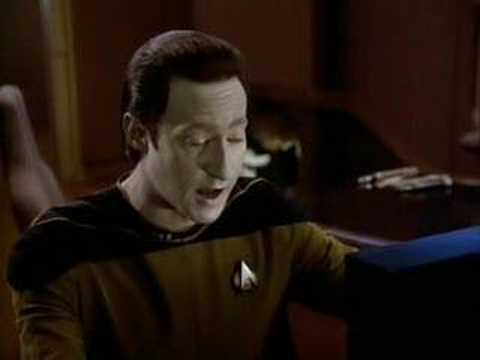
DATA I envisioned as the Scarecrow since the Scarecrow seeks a brain, but is already unknowingly the “wisest man in Oz.”  DATA seeks to become human, but as is inferred in many episodes, is perhaps the most human of them all.

YouTube Preview Image

Johnny 5 is the most robotic looking character I chose, and I used him to represent the Tin Man.  Johnny 5 gains sentience through an accident and spends the film learning about life and shying away from his destructive military programming.  I felt it was an interesting correlation to gaining respect for life and finding a heart.

YouTube Preview Image

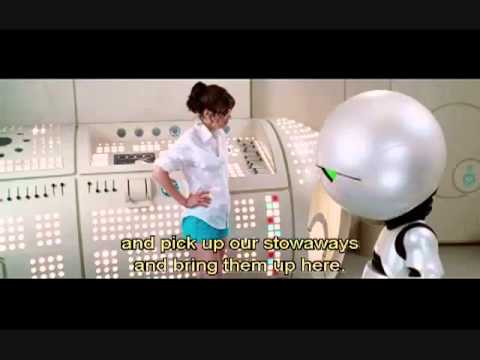
Finally, Marvin from the Hitchhiker’s Guide to the Galaxy seemed perfect as the Cowardly Lion.  Both characters are so over the top and dramatic that they just seemed to fit.

YouTube Preview Image

I found the images through Google and used Microsoft Paint and Word to bring them together.  I suppose that I could have used Photoshop to make it more polished, but the result I achieved through Word suited my needs, so I went with it.

I loved reading the comments, and I think in many ways my view of the piece that I created has now changed after reading the viewpoints of others.  I can see what they see, and am surprised by what others have found or inferred that was beyond my original intent.  It makes me wonder how I am perceiving other people’s works, and how my perception differs from the intent of the author.  Do any of us ever really see the original author’s point, when we look at things with our own life goggles…

Posted in Uncategorized | Comments Off

Lifestream 4

While discussing uncanny pedagogies, Bayne (2010) lists Lifestream as an example of something that captures the spectrality of one’s digital existence. What is this digital existence? Hook (2005 in Bayne, 2010) deconstructs it as a ‘disembodied presence’ and, what is more interesting, an ‘embodied absence’. Although the latter refers to the presence of our representation online while we go offline it is fascinating to see how this absent presence, instead of being static and fixed, is dynamic and subject to constant activity

The lifestream by being an example of a digital text, that is volatile, fragmented, distributable and doubtful in terms of its authorship (Bayne 2010) illustrates this dynamism very well, especially in terms of temporal and ontological blurring.

Unable to log on every day, I create discontinuity in the stream. However, the software sometimes fills in those gaps by tampering with the time stamp of a given feed. So although physically offline one day, it looks like I am present. Would that be an example of disembodied presence, a very convoluted example due to the feed being time-stamped backwards!? This happens because the software seems to be taking into account the date the online resource was posted, not when I favourited it. So to make things even stranger my absence/presence has been embodied by somebody else’s online activity.

Immediate questions arise as to the authorship. Who is creating this stream? How can you-not-being-there be assessed ? Uncanny indeed!


Posted in lifestreammaries | Tagged , , | Comments Off

Limit to Limitlessness?

The ‘unheimliche’ liquidises boundaries in various areas of ontological significance and so disrupts the sense of presence, time, space, nodding to Delueze and Guattari’s interweaving concepts of deterritorialisation and reterritorialisation. Due to that, online learners and tutors are rendered as spectres and ghosts often experiencing an ontological dissonance, being at a loss where to position themselves in the new online landscape.

So, the classroom has been emptied with the students and tutors fleeing online to populate and interact, supposedly often in greater intimacy, in multiple online spaces. The material reality of ‘here’ has given way to imagined ‘there’, a fluid space with ‘few, if any fixed compass bearings’ (Barnett, 2007). The physical body has been discarded too in favour of the spectrality, the disembodied presence , strangely enough, the embodied absence, the representation of you living online long after you’ve logged off. The temporal and multiple synchronicity deepens the ontological blurring even more.

Instead of attempting to normalise the situation by bridging the gap created by temporal and spatial disjunctures, Bayne (2010) suggests embracing thus induced uncertainty as something generative, constructive and transformative.

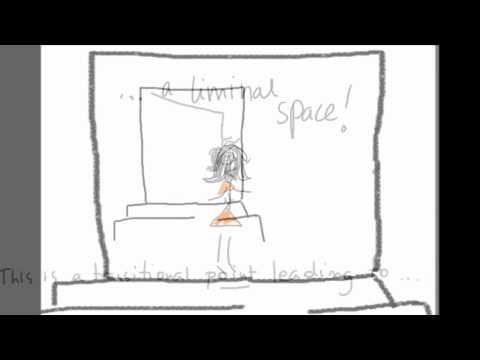
In general I agree with such a proposition – planes of doubt look to me as environments which might be more conducive to creativity than fixed frames of traditional practices and the liminal space of becoming seems much more interesting than the fixed point of departure or the destination, something I tried to capture in my video on liminal spaces I produced last year for IDEL.

YouTube Preview Image

There is however one issue I’ve got with the ontological turn the uncanny pedagogies are trying to implement. What is the limit of stretching one’s capacity for assimilating and producing strangeness? Is there a limit? Should this be even mentioned in the discourse with lack of boundaries as the basic premise?

If I’m rendered a ghost online how can online-me be there or anywhere? Does haunting equal being? What could anchor me in the online environment? Even the lifestream seems a hoax, breadcrumbs left by me but swept and arranged by technology according to its will. A fabricated piece of evidence. The growing isolation. The mounting uncertainty. The fragmentation of me, the online doppelganers render the physical-me a ghost too, as I close off from the physical reality and latch onto the online. I am neither there or here. It might be a productive space, yes, but there are limits to how much of intellectual uncertainty an individual can bear without going insane. Or is that a part of the ontological turn too, reaching the threshold of tolerance where the balance is tipped and you plunge/are thrown into the deep waters? Perhaps the limit I’m feeling frustratingly as very close is like other boundaries, ‘illusions, wisps of white that beckon to use just out of reach, that dissolve as we pass our hands in front of our faces’ (Kochhnar-Lindgren, 2009:5).


Posted in musings, readings | Tagged , , | Comments Off

AI – Avatar Identity – Beneath

An ususual view from under the water looking to all the clones and avatars above the water’s surface. Following a rescue trip to bring out stranded avatars (me, he, she, us, them) who had got knocked into the water…

Posted in EDC11 | Tagged | Comments Off

AI – Avatar Indentity – Machinima

YouTube Video at http://www.youtube.com/watch?v=5Sa8Fdc5U-0

Posted in EDC11 | Tagged | Comments Off