Why the dichotomy?

The films at the first festival were interesting illustrations of the polarised views of the impact of technology on society. Both Collossus and Bendito Machine depict a swing from hopeful utopian visions of the benefits of technology to society, for example world peace in Collossus, to the dystopian fears associated with technology taking control resulting in a loss of human agency etc. For me, a question that these films raised was why are these positions polarised? Why don’t we see positions representing a spectrum of possibilities along the dystopian/utopian continuum? Why the dichotomy? Two elements from my lifestream offer some explanations for this. The Gartner hype cycle describes a cycle of expectations from inflated promise to dissolution associated with the appearance of new digital technologies and their assimilation into our digital environment. While the initial excitement surrounding a new technology might align with a more utopian view in terms of its impact on society, the trough of dissolution does not necessarily represent a dystopian perspective.

However in an article I came across recently Fisher (2001) does unpick these polarised view points in terms of Ogburn’s theory of ‘cultural lag’. The idea put forward is that it takes time for a technology to become assimilated into the cultural landscape and that early in the process of assimilation opposing positions are voiced representing hopes and fears rather than actualities. As the technology becomes embedded in the fabric of society knowledge increases about what its capabilities are and so claims about its impact become less extreme. Interestingly the process of assimilation seems to be as much about society being shaped by the technology as vice versa.

Posted in Uncategorized | Comments Off

Thoughts on Cyberspace

Hackers - Crash and Burn
Hackers - IMDb
While reading the Bell (2001) article I kept remembering the movie Hackers from 1995.  The teen stars are counter culture and fighting the man… everything from their style of dress to their attitude is counter culture, punk influenced… and perhaps could be described as cyber punk.

I loved the idea of being able to use a computer to change and shape the world.  Perhaps this and other similar movies are why I started studying computers in the first place.  Or maybe just my desire to “fight the man.”  Looking back now, I’ve come to realize that although I still root for the underdog and the anarchists, I have become the “man.” :(

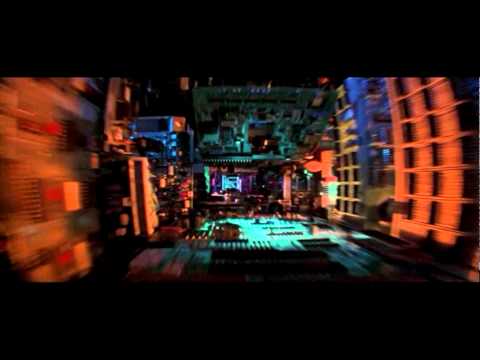
What struck me most about the movie, and about most Hollywood movies dealing with computer hacking is not only how they make it seem so easy, but how graphically they illustrate the process.  Hacking the Gibson (perhaps an homage to William Gibson who Bell identifies as “the author who defined the genre as well as defining the cyberpunk version of cyberspace”)  is seen as flying through building like structures to a destination… As Bell (2001) describes cyberspace as “resembling the urban landscape, with flows of data like traffic and banks of data like skyscrapers”

YouTube Preview Image

The Matrix
Has Hollywood’s vision of cyberspace been accepted as true by the masses?  With the popularity of films like the Matrix and Tron, we must ask if those who do not know any different actually believe that data can be interacted with in this way?  Is it just that it is so alien that they must humanize it, and associate it with things they could relate to?  i.e. urban landscapes

If we imagine taking a person from a culture not exposed to technology, where perhaps they believe that taking a picture steals your soul, how might they react to being exposed to a virtual world like Second Life?  Could they be convinced that the avatars which they could create and control are not in fact part of themselves that have become integrated with the machine?  Is Hollywood playing into this notion that we are perhaps afraid of what cyberspace might become, or is it as Bell states that we are constantly “shifting our overall perspective on cyberspace and our place within it?”

Posted in readings | Comments Off

The Monster is Within

While reading Margrit Shildrick’s paper on monsters, I couldn’t help seeing parallels between a female body she uses as an exponent of a monstrous body and a digital body (being it an individual avatar or technology in general). Shildrick lists characteristics of female bodies (and the bodies of other ‘others’) such as leaky, unstable, labile, unbounded and uncontained, always in flux, subject to change, reproducing, excessive and in surplus, which assist the body in making the transition from the comfortable absence (‘comfortable’ when the body is looked at bounded and stable) to troublesome presence, whereby the body with all its frivolity and volatility imprints itself in the consciousness. It’s the celebration of the monstrous body – Shildrick proclaims at the beginning of her paper.

The reasons for such festive inclinations are numerous but the most important one is that of the need to emphasise the process, the flux, the instability as inherently natural and human.  This way she avoids positioning herself as an opponent of humanism as abandoning binary dichotomies and blurring the boundaries might establish, in her view, a  rich breeding ground, where transformation is born, which echoes the rhizome proposal of Deleuze and Guattari.

What Shildrick also stresses in her paper is the promise embodied in the liquidity, not the threat. While reading about the uncanny digital technologies last year I was not sure if the fragmentation caused by the multiplying online traces of my digital escapades and practices are something worth seeking after. I felt simultaneously attracted and threatened by the prospect, thrilled by the enhanced modes of being and feeling but alarmed by the possibility of losing sanity, succumbing to the power of my avatars, becoming dehumanised, the everlasting friction between the technoutopia and dystopia, a view still entrenched in ‘either … or’ perception of the world and subjectivity, based on binarism and thus on exclusion. The exclusion can never be complete according to Shildrick as the boundaries are liquid and permeable, allowing multiple incorporations which are at the forefront when it comes to innovation, creativity and imagination and so opening up different world, modes of being and becoming. This is a richer reality, enlarging not restricting  human subjectivity, embodying it and not disembodying.

While researching monstrous bodies I came across digital manipulations of the human body in art, crossing the boundaries between the human and machinic, between the disabled and the healthy. One of the projects struck me in particular. In the process of digital imagining the basic senes of smell, sight, taste and hearing got overgrown with thick layers of skin (thus excluded), giving an overall grim and dystopic look to the technological face, this way probably emphasising the desensitising threats. I would argue that this could be indeed the case if we persist identifying and maintaining the boundaries sealed.

The eyeless body might appear anti-human but uncannily by liquidising some of the senses and leaving one, the skin a very sensitive organ, it fosters new receptiveness.


Posted in musings, readings | Tagged , , | Comments Off

Lifestream 2

Still playing with my stream, mastering it (by the way ‘master’ is an anagram of ‘stream’).
What does ‘stream’ mean?
To discover what it means for me, I invite you to play with the letters below:

Posted in lifestreammaries | Tagged , , | Comments Off

Delicious and the lifestream

hi again, everyone!

As you probably know, Delicious changed hands last week, and the default lifestream feed for the site is no longer working.

I’ve solved this for my lifestream in the following way (full instructions for customising the new delicious feeds are at http://www.delicious.com/help/feeds ):

Go to your blog dashboard and to the lifestream section. Click “Generic” to add a new basic RSS feed.

Enter the feed like this:

http://feeds.delicious.com/v2/rss/username/tag (replace “username” with your Delicious username, and “tag” with whatever tag you want to restrict your bookmarks to. The tag restriction is optional).

Change the title of the feed to something like “New Delicious” or whatever you like.

If you want to keep the Delicious icon, you can use the one at http://edc11.education.ed.ac.uk/wp-content/plugins/lifestream/extensions/delicious/icon.png

This will only get you the last 10 bookmarks by default, so you may want to keep your old delicious feed as well.

Comment here if you have any problems or questions!

Jen

Posted in Information | Comments Off

It’s week three – do you read me?

Hi all, and welcome to week 3!

The lifestreams are really starting to pick up steam now, fed by the excellent tweets and blog posts from the past two weeks and your other content that is either rushing or trickling in. Your tutor will be giving you some mid-way lifestream feedback in week 5, but feel free to get in touch with us before that if you have any questions about how it’s going.

So, on to the activities, readings and themes for the next fortnight. From today, we shift focus from popular cyberculture to one aspect of its emergence in education: multimodality, visuality and other ‘new literacies’. The readings for this week and next will explore some of these themes as the course in general takes a ‘visual turn’. We’ll be looking at the theory and at the same time everyone will have a chance to represent their own ideas visually, through construction of a visual artefact for the end of next week.

Discussion this week is going to be via Skype text chat. This will be held on Wednesday 5th October, 8pm (BST), and will last about an hour. Please make your tutors Skype contacts before the event:

sianbayne1
jross28
j_k_knox

We will focus on the core readings for this chat session: Bayne, Kress and Thomas et al. Looking forward to hearing your thoughts on these!

Please also continue to tweet course-related material to #ededc, which is becoming a really lively stream of course conversation. And remember you can access all the blog postings here if you want to see what others are writing about in longer form.

Have a great week. :-)

Posted in Weekly Welcomes | Comments Off

Week 2 Summary

Already the beginning of week 3! Whilst reassuring myself that we are still at the beginning of the course I realise that I must remind myself that it is only a 10 week course and the time will fly in. Compared to registering accounts, organising feeds and then ‘playing’ to work out how to navigate my way around them I do not feel I have given a sufficiently proportionate time to the course content this week. However, for now I am reassuring myself that this is essential work as not having the feeds set up properly will restrict me in representing what I’ve been reading/doing. I’ve always been resistant to Twitter until now, with perhaps a dated view, that that if someone really wants to know my opinion (and I want to share it) it is better done on a one to one basis. Having set up Twitter I now realise how dated my thinking was….because you can private message on twitter too! I have followed the advice and organised a Tweetdeck account. This has made managing the course a little easier as I am in a position to follow some of the comments by separating them from personal messages. That said I’m finding conversations disjointed when reading them a day or so later and this makes it less effective to contribute through this medium.

Posted in Weekly blogs | Comments Off

Summary: Week 2

This week we’ve been considering the themes of Being Human and Other Worlds (lifestream 04.10.2011 #5).  Being somewhat of a gamer and virtual reality hobbyist, the notion of Other Worlds holds particular interest for me and seems to tie in well with the readings and discussions from last week.  However my ramblings across the web while considering this topic have started to get me thinking about the nature of this reality and how we experience it.  If all of our neural impulses are prompted by nothing more than electrical signals from our nervous system, then we are each of us living inside our own heads.  Each of us is experiencing their own virtual reality and no doubt colouring it with the emotional or experiential baggage that defines us.  When considered thus, we can actually make the astonishing claim that there is no such thing as one absolute definition of reality.  Indeed the very reality that we experience can never be truly shared because the sharing must take place via our nervous systems.  It’s almost analogous to the idea of different game play experiences due to graphics card irregularities or broadband speeds amongst gamers.

Considering all this, and if we really are just brains in meat vats (lifestream 01.10.2011 #1), experiencing the world through our senses (plus the technological prosthesis we attach to them, i.e. networks, monitoring software, information systems, etc), how can we ever hope to share a common culture, digital or otherwise?  How can we be sure that our interpretation of anything is close enough to that which is experienced by another?  How can we be sure that there even are other people?  The unavoidable conclusion is that we cannot.  But to admit to such feels almost like fatalism, and perhaps the only recourse is to swallow the blue pill, and stubbornly carry on creating and sharing in this (hopefully) common culture.

Some videos that have informed this contemplation:

What is real?

YouTube Preview Image

There is no spoon.

YouTube Preview Image

Plato’s Allegory of the Cave.

Posted in Cyborgs, ELearning and Digital Culture, Miscellaneous Techno Babble | Tagged , | Comments Off

Week 1 Summary

This has been an entirely overwhelming week resulting in failing my personal objective of producing daily contributions, as the week was over before I realised it had begun. Unfortunately, a disproportinate amount of time was spent on the basics that I had taken for granted that I would grasp without difficulty as opposed to course content and demonstrating an insight into the readings. I have set up accounts with Twitter, Delirious and explored WordPress. Hours can be lost sifting abundant internet resources for relevant content but more often being distracted by interesting (though not directly relevant for that moment in time) information. WordPress appears to be the biggest of my distractions as I can easily spend a precious evening rearranging my widgets and creating my avatar with no direct benefit to the course content….lesson learnt here!
I provided a delirious contribution but wish to develop my usage of delirious further as I see this is a very useful tool in online sharing. My tweets allowed me to participate in some way with the film festival (I was unfortunately unable to attend the synchtube session this week) and successfully linked to my Lifestream.
The readings are challenging! There is a cyberdictionary’s worth of new terminology for me and whilst I hope to have drawn some worth from them I look forward to re-reading them in a few weeks (as my experience of digital cultures develops) and having better appreciation of the emerging themes.

Posted in Weekly blogs | Comments Off

Trials and tribulations of Lifestream

My day has been spent finding my way around Prezi. This application came highly recommended to me so I abandoned my attempts with Tumblr and began exploring Prezi. My plan was to look through the Synchtube session notes from the Twittorial on Thursday 29th October, and present our thoughts/views using this application.

For quickness and ease of use I decided to use one of the templates on offer. I have spent 6 hours so far working on this. It’s amazing how much time it takes. I feel I’m now one with my chair, desk and laptop. And now I’ve hit a problem. I seem unable to link the presentation to my Lifestream. At the moment,  I feel I take two steps forward and four back in any coursework I attempt to do. Progress is slow.  There are a number of things I still need to do, such as add tags, and change appearance.  I do have YouTube working and I may need to have another stab at Tumbr. I look in awe at the work my colleagues have done, and are doing;  they seem to be such experts.  I was reassured by Ania when she said she also faced problems at the beginning.

I’m adding the link to my World builder presentation in the hope that it’ll work in the blog’s published form. Just in case it doesn’t I’ll insert a screenshot to give a flavour of how the presentation looks. It’s by no means comprehensive, I’m still experimenting.  In the meantime I shall continue to play around with it. I may even be able to resolve my problem.


Posted in Uncategorized | Comments Off